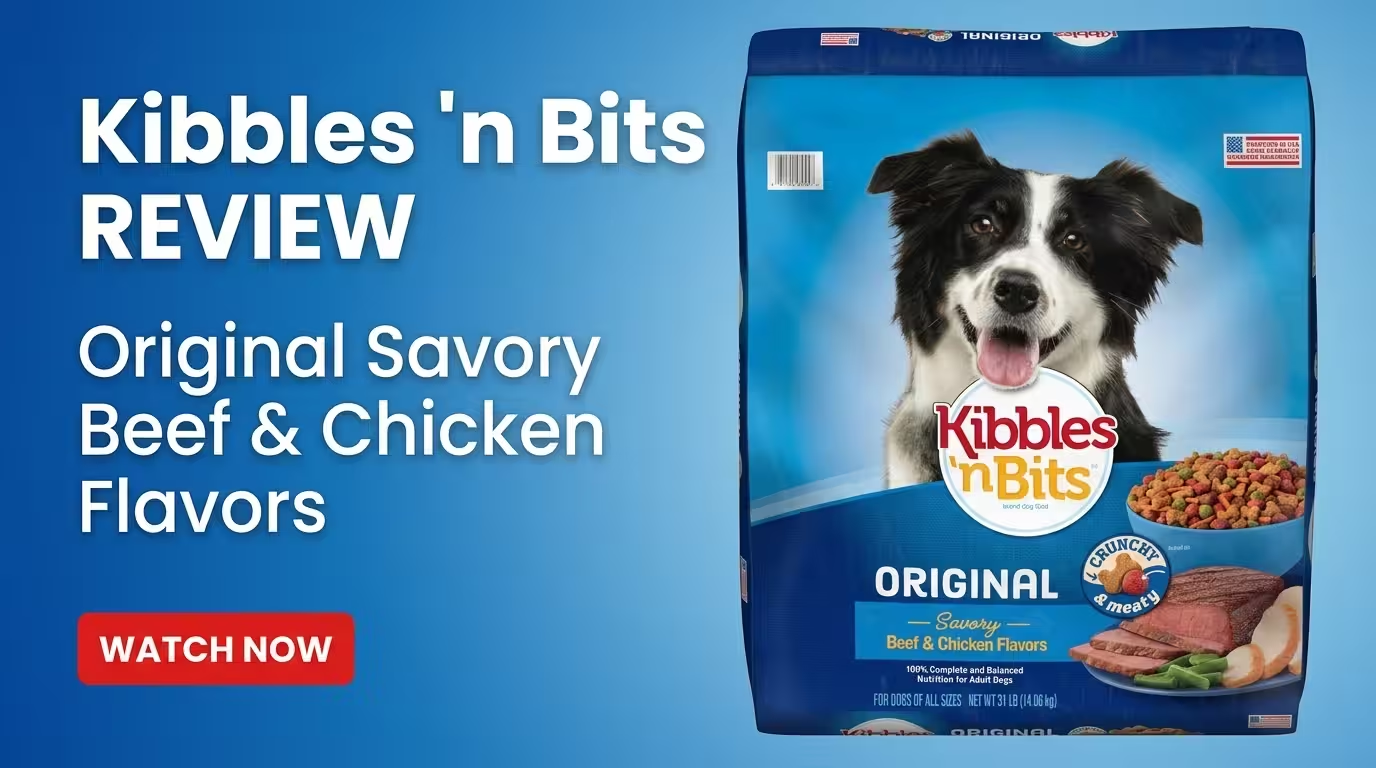
I want to start this review by acknowledging something. Kibbles ‘n Bits is one of the most recognizable dog food brands in America. It’s been around since the 1980s, it’s on the shelf at literally every grocery store, and millions of people feed it to their dogs every single day. Some of those dogs live long, seemingly healthy lives. I’m not here to dismiss that reality.
What I am here to do is give you the honest picture — the ingredient quality, the actual nutritional profile, and what I observed over 30 days of feeding it to three real dogs in 2026. Because I think a lot of people buy this food without looking closely at what’s actually inside the bag.
I bought a 35 lb bag in early 2026, committed to the trial, and tracked everything the same way I track every food I review. Here’s what happened.
Product Overview: Kibbles ‘n Bits Original Savory Beef & Chicken Flavors
Kibbles ‘n Bits is manufactured by J.M. Smucker Company, which also owns Milk-Bone and other pet brands. The Original formula is their flagship product — that distinctive mix of kibble pieces and soft, chewy bits that give the brand its name and its visual distinctiveness.
The “beef and chicken flavors” branding is important to note — these are flavors, not the primary protein sources. The distinction matters enormously when you look at the ingredient list.
Key Details:
- Brand: Kibbles ‘n Bits (J.M. Smucker)
- Formula: Original Savory Beef & Chicken Flavors
- Life Stage: Adult dogs (1+ years)
- Target: All breeds, all sizes
- Primary Ingredient: Corn (not beef or chicken)
- Available Sizes: 3.5 lb, 7.5 lb, 17.6 lb, 35 lb, 55 lb bags
- Price Range: $8–$35 depending on size (USA retail)
- Where to Buy: Walmart, Target, Kroger, Dollar General, Amazon, literally everywhere
Quick Verdict: Kibbles ‘n Bits Original is among the lowest quality dog foods I’ve tested in twelve years. The first ingredient is corn. The protein comes primarily from corn gluten meal and soy. It contains artificial colors, BHA preservative, and corn syrup. All three of my dogs showed declining health indicators by the third week. This is not a food I can recommend for long-term feeding under any circumstances.
Meet My Three Test Dogs
🐶 Scout — Beagle Mix, 5 Years Old, 24 lbs
Scout is my nose-to-the-ground, permanently distracted, cheerfully disobedient hound mix who has turned selective hearing into an art form. He’s always hungry, always sniffing something, and always convinced there’s a better smell just around the next corner. He’s got a smooth, tri-colored coat that shows nutritional changes reliably, and a digestive system that’s been mostly solid — until this trial.
🐶 Rosette — Poodle Mix, 4 Years Old, 18 lbs
Rosette is my curly-coated, smart-as-a-whip poodle mix who has figured out how to open the refrigerator and absolutely would eat things she shouldn’t if given the opportunity. She’s energetic, clever, and her curly coat requires consistent nutritional support to stay in good condition. She’s also my best indicator for cognitive changes — Poodles show mental sharpness shifts fairly quickly when something’s nutritionally off.
🐶 Kong — American Akita, 6 Years Old, 95 lbs
Kong is my dignified, reserved, deeply loyal Akita who communicates almost entirely through extremely subtle body language and occasional meaningful sighs. He’s imposing to look at but is genuinely gentle with people he trusts. At 95 lbs, he has serious nutritional needs, and his thick double coat is one of my primary health indicators. When his coat suffers, it shows dramatically on a dog with his fur density.
My 1-Month Experience — Thirty Days of Gradual Concern
Six-day transition for all three dogs, mixing Kibbles ‘n Bits with their previous food in increasing proportions. No dramatic transition-period issues, which gave me an early sense of false optimism. The problems that developed came later and more gradually.
🐶 Scout — Beagle Mix
Energy Levels: Scout’s energy was adequate for the first two weeks. He was still dragging me toward interesting smells on walks, still demanding his after-dinner zoomies in the backyard. By week three, though, he was visibly less enthusiastic about his evening activity. He’d still go for walks, but without his characteristic urgent pulling toward every tree. By week four, he was noticeably more sedentary in the afternoons — napping longer, initiating play less frequently.
Digestion: Scout’s digestion was where the problems became most obvious. Starting around day eight, his stools became noticeably softer and more frequent. By week two, he was going three to four times per day instead of his usual twice, and the consistency was consistently loose — not liquid diarrhea, but definitely not healthy. The stool smell was notably worse than his baseline. This persisted without improvement throughout the entire month.
Coat Condition: Scout’s short, tri-colored coat lost its sheen by week three. It went from a healthy, smooth appearance to looking slightly dull and rough — like the coat of a dog who isn’t getting enough essential fatty acids. I was brushing out more dead hair than normal. The change was gradual but clear.
Behavior: More restless. Started eating more grass on walks. Occasionally seemed uncomfortable in the evenings — shifting positions more frequently, which I associate with mild digestive discomfort.
Issues: Persistent soft stools for the entire three weeks after transition, coat quality decline, energy reduction, and increased grass-eating. Scout had a rough month on this food.
🐶 Rosette — Poodle Mix
Appetite: Rosette was initially enthusiastic about this food. The soft “bits” component of Kibbles ‘n Bits clearly appealed to her — she’d eat those first, then work through the kibble pieces. The palatability is engineered to be high, and it worked on her. But by week three, she was leaving more in her bowl than usual, suggesting even the artificial palatability was wearing thin.
Weight Changes: Rosette went from 18.0 lbs to 18.9 lbs in a month. Nearly a full pound on an 18 lb dog — almost 5% of her body weight. I was following the feeding guidelines exactly. This kind of weight gain on standard portions is a significant red flag, suggesting the caloric profile and carbohydrate content of this food don’t align well with what the feeding guidelines imply.
Stool Quality: Poor throughout weeks two through four. Softer than her baseline, higher frequency, noticeably unpleasant odor. High stool volume — larger than I’d expect from an 18 lb dog, which indicates poor nutrient absorption.
Cognitive Sharpness: This is subjective, but I noted it in my tracking journal: Rosette seemed slightly less sharp in her training sessions during weeks three and four. She’s normally extremely quick to pick up cues and perform known behaviors. During this month, she seemed more distracted and took longer to respond. I don’t know if this is food-related — blood sugar fluctuations from high-corn diets can affect cognition — but the timing was consistent with the other declining indicators.
Issues: The weight gain was the most alarming outcome for Rosette. Nearly a pound in a month is not a small thing for a dog her size. Combined with poor stool quality and the possible cognitive observation, her month on Kibbles ‘n Bits was not good.
🐶 Kong — American Akita
Strength & Muscle Tone: Kong maintained his general mass throughout the month, but I felt — and this is the kind of observation that only comes from putting your hands on a dog you know well — that his muscle tone was slightly softer by week four. He didn’t lose weight (95 lbs throughout), but the density and firmness of his musculature seemed reduced. At 22% protein, mostly from plant sources rather than animal protein, his body composition seemed to be subtly suffering.
Immunity & Overall Health: Kong had a mild hot spot develop on his back right hip during week three. He’s had hot spots before occasionally, so I can’t definitively attribute it to the food. But the timing, combined with everything else I was observing, made me suspicious that the nutritional shortfalls were contributing to skin susceptibility.
Coat: This is where I was most troubled. Kong’s Akita double coat is his most spectacular feature — that thick, plush undercoat and harsher outer coat require serious nutritional support. By week three, his coat texture had changed. It felt drier and less dense. When I brushed him, the amount of dead undercoat coming out was significantly higher than his normal shedding. The coat wasn’t just less healthy-looking — the texture under my hands felt different, which is the kind of change I’ve learned to take seriously.
Activity: Kong’s naturally dignified, measured pace became even more measured. He was showing less enthusiasm for his evening walks. He still walked, but with reduced initiative. Kong’s version of energetic is restrained by nature, so this was a subtle shift — but real.
Issues: Hot spot development, significant coat quality decline, subtle muscle tone changes, and reduced activity interest. For a six-year-old Akita, these are concerning trends.
Nutritional Information Breakdown
| Nutrient | Value | Ideal Range | Verdict |
|---|---|---|---|
| Crude Protein | 22% | 20–30% | ⚠️ Low-Average — barely adequate, mostly plant-sourced |
| Crude Fat | 8% | 10–20% | ❌ Below minimum — inadequate for most adult dogs |
| Crude Fiber | 4% | 3–5% | ✅ Acceptable |
| Moisture | 14% | Up to 12% | ⚠️ Higher than typical — due to soft bits |
| Calories | ~308 kcal/cup | — | Very low energy density |
This is not a good nutritional profile for long-term feeding.
Here’s why each number matters:
Protein at 22% looks acceptable at a glance. But when you understand that the protein comes primarily from corn gluten meal, soybean meal, and meat and bone meal (an unspecified, vague by-product), the number becomes much less reassuring. These are low-quality, poorly bioavailable protein sources. Your dog’s body cannot use plant protein and mystery by-product meal as efficiently as it uses named animal protein. The effective nutritional value of this 22% is substantially lower than it appears.
Fat at 8% is seriously inadequate. The minimum I’d consider acceptable for coat health, energy, and fat-soluble vitamin absorption is 10%. At 8%, the inadequate fat content directly explains Kong’s coat deterioration and likely contributed to Scout’s and Rosette’s coat changes as well.
Calories at ~308 per cup are very low — requiring you to feed large volumes to meet caloric needs, which means a lot of corn and filler passing through your dog’s system daily. This explains the high stool volume across all three dogs.
The Artificial Color Situation:
Kibbles ‘n Bits contains Red 40, Yellow 5, Yellow 6, and Blue 1. Four artificial colors. These make the food look visually interesting to humans. They provide zero nutritional value to dogs. Some studies suggest potential links to behavioral changes and allergic reactions in sensitive animals. This is pure cosmetic marketing — and it’s in a food that’s fed to millions of dogs daily.
BHA Preservative:
The formula contains BHA (butylated hydroxyanisole) as a preservative. BHA is a synthetic antioxidant that the National Toxicology Program has listed as “reasonably anticipated to be a human carcinogen” based on animal studies. Its safety in dog food is not definitively established. Many higher-quality foods have moved to natural preservatives (tocopherols, rosemary). The continued use of BHA in 2026 is a genuine concern.
Ingredient Analysis — The Most Concerning List I’ve Reviewed
Top 5 ingredients:
- Ground Yellow Corn — First ingredient is corn. Not beef, not chicken. Corn. A cheap grain filler that provides calories and enables cheap plant protein addition via corn gluten meal. Rating: Low-quality.
- Soybean Meal — Second ingredient is soybean meal — plant-based protein that inflates the protein percentage. Dogs cannot utilize soy protein as efficiently as animal protein, and soy is a common allergen. Rating: Low-quality.
- Beef and Bone Meal — The third ingredient is finally an animal protein, but it’s beef AND bone meal — vague, unspecified quality rendered product. The bone content significantly reduces the protein quality. Rating: Low-quality.
- Corn Syrup — Corn syrup. The fourth ingredient in a food marketed as nutritious dog food. This is a sugar source that serves one purpose: making the food addictively palatable so dogs keep eating it. It contributes empty calories, promotes blood sugar spikes, and may contribute to weight gain. Rosette’s nearly-one-pound weight gain in a month likely has a relationship with this ingredient. Rating: Unacceptable.
- Wheat Flour — Another grain filler. Provides carbohydrates. Common allergen. Fifth ingredient and we’ve still seen no quality animal protein. Rating: Low-quality.
Overall Ingredient Quality Rating: Very Low. The first two ingredients are plant fillers, the third is a vague by-product, the fourth is corn syrup, and the fifth is wheat flour. There is no quality animal protein in the top five ingredients of a food with “Beef & Chicken Flavors” on the front of the bag. The beef and chicken are flavoring agents — not meaningful nutritional components.
Pros & Cons — After 30 Honest Days
✅ Pros
- Extremely cheap — among the lowest prices per pound of any dog food
- Available literally everywhere — every grocery store, gas station, big-box store
- Dogs will eat it — the corn syrup and artificial flavoring ensure high palatability
- The soft bits texture appeals to many dogs — novel texture combination
- Meets bare AAFCO minimum standards — technically “complete and balanced” at the minimum level possible
❌ Cons
- First ingredient is corn, not meat
- Corn syrup as the fourth ingredient — sugar in dog food is unacceptable
- Contains BHA — a synthetic preservative with documented health concerns
- Contains four artificial colors — Red 40, Yellow 5, Yellow 6, Blue 1 — no nutritional value
- Fat at 8% is below adequate — directly caused coat quality decline in all three dogs
- All three dogs developed soft stools that persisted throughout the trial
- Scout’s energy declined significantly by weeks three and four
- Rosette gained nearly a pound on standard portions in one month
- Kong developed a hot spot and significant coat quality decline
- Protein is mostly plant-sourced — corn gluten meal and soybean meal dominate
- Very low calorie density means high stool output and poor absorption
- “Beef & Chicken Flavors” is misleading — these are flavoring agents, not meat content
Price Breakdown (USA — All Prices in $)
| Bag Size | Approximate Price | Price Per Pound | Price Per Kg |
|---|---|---|---|
| 7.5 lb | $8–$10 | ~$1.20/lb | ~$2.64/kg |
| 17.6 lb | $14–$18 | ~$0.91/lb | ~$2.01/kg |
| 35 lb | $22–$28 | ~$0.71/lb | ~$1.57/kg |
| 55 lb | $30–$36 | ~$0.60/lb | ~$1.32/kg |
Prices based on Walmart, Target, Kroger as of early 2026.
Monthly Cost Estimates:
Low calorie density (~308 kcal/cup) means feeding large volumes:
- Small dog (Rosette, ~18 lbs): ~1 cup/day → 17.6 lb bag lasts ~2.5 weeks → ~$22–$29/month
- Medium dog (Scout, ~24 lbs): ~1½ cups/day → 35 lb bag lasts ~6+ weeks → ~$14–$18/month
- Large dog (Kong, ~95 lbs): ~4.5 cups/day → 55 lb bag lasts ~3.5 weeks → ~$34–$41/month
Value for Money Verdict: Looks cheap. Does not represent good value. The low calorie density means you’re feeding more volume than you’d feed of a higher-calorie, better-absorbing food — so the per-meal cost advantage is smaller than the bag price suggests. And when you factor in the potential for vet bills from skin issues, digestive problems, and long-term nutritional deficiencies, the apparent savings disappear entirely.
For $8–$10 more per month, Scout could eat Kirkland Nature’s Domain. For $5–$8 more per month, Rosette could eat Purina ONE SmartBlend. Both are dramatically better in every measurable category. The math doesn’t favor Kibbles ‘n Bits.
Comparison Table: Kibbles ‘n Bits vs. Competitors
| Feature | Kibbles ‘n Bits Original | Royal Canin Medium Adult | Pedigree Complete | Purina ONE SmartBlend | Kirkland Nature’s Domain |
|---|---|---|---|---|---|
| Protein % | 22% | 27% | 21% | 30% | 24% |
| Fat % | 8% | 17% | 10% | 17% | 14% |
| Fiber % | 4% | 1.3% | 4% | 3% | 3% |
| Price (35 lb bag, $) | $22–$28 | $58–$68 | $22–$28 | $38–$44 | $35–$40 |
| First Ingredient | Ground Yellow Corn | Dehydrated Poultry | Corn | Chicken | Turkey Meal |
| Contains Corn Syrup | Yes | No | No | No | No |
| Contains BHA | Yes | No | Check label | No | No |
| Artificial Colors | Yes (4 types) | No | Yes | No | No |
| Protein Quality | Very Poor | Average | Low | Good | Good |
| Best For | Nobody honestly | Breed-specific | Extreme last resort | Mid-range value | Best budget pick |
| Rating (/10) | 2.5 | 7.2 | 4.5 | 7.6 | 8.3 |
Where Kibbles ‘n Bits Actually Stands:
Looking at the best dog food in USA 2026, Kibbles ‘n Bits sits at the very bottom. Its protein is below Pedigree (already a low bar). Its fat content is half what Purina ONE provides. Corn syrup and BHA have no legitimate place in a quality dog food in 2026. The ingredient list is arguably worse than Pedigree’s, which itself I’ve rated poorly.
Is Kibbles ‘n Bits good for dogs? Based on this trial and the nutritional analysis — definitively no.
Final Rating: 2.5 / 10
| Category | Score (/10) |
|---|---|
| Ingredient Quality | 1.5 |
| Nutritional Profile | 2.5 |
| Digestive Performance | 2.5 |
| Coat & Skin Health | 2.0 |
| Palatability | 6.0 |
| Value for Money | 3.0 |
| Overall | 2.5 |
Verdict: Not Recommended — One of the Worst Dog Foods Available in the USA in 2026
Kibbles ‘n Bits Original Savory Beef & Chicken Flavors failed my trial in almost every meaningful category. All three dogs had declining health indicators. Scout had persistent digestive problems. Rosette gained alarming weight. Kong’s coat deteriorated and he developed a skin issue. The ingredient list — corn, soybean meal, vague bone meal, corn syrup, wheat — is among the worst I’ve reviewed.
The only thing this food does well is taste good to dogs, thanks to corn syrup and artificial flavoring. That’s not a recommendation. That’s a warning.
Would I Buy It Again?
No. I would NOT recommend this dog food.
I switched all three dogs back to their regular food immediately after the 30-day trial ended. Within two weeks: Scout’s stools firmed up and normalized. Rosette started losing the weight she’d gained. Kong’s coat started looking better. The recovery timeline alone tells you what the food was doing to them.
If you’re currently feeding Kibbles ‘n Bits, I genuinely encourage you to look at alternatives. Purina ONE costs $8–$15 more per month for a medium dog and is dramatically better. Kirkland Nature’s Domain is similarly priced (with a Costco membership) and dramatically better. You don’t need to spend $80/month on Orijen to do right by your dog. But you do need to spend more than $0.60–$0.91 per pound on their food.
Who Should Buy Kibbles ‘n Bits?
The honest answer: essentially no one.
Narrow edge case only:
- Absolute financial emergency where this is the only food you can access and your dog needs to eat something
- A few days of feeding while transitioning to something better
Everyone else should look elsewhere:
- Budget owners: Purina ONE, Iams ProActive Health, Kirkland — all meaningfully better at small price increases
- Dogs with any sensitivity: corn, soy, wheat, and artificial additives make this a minefield
- Any breed: no dog deserves corn syrup and BHA as core dietary components
- Senior dogs: inadequate protein quality and fat content at a critical life stage
- Puppies: this food is not appropriate for growth stages
My Final, Honest Words
I’ve reviewed foods I didn’t expect to like and found reasons to appreciate them. I’ve reviewed expensive premium foods and called out their weaknesses honestly. I try to approach every trial without preconceptions.
Kibbles ‘n Bits didn’t give me anything to appreciate beyond palatability — and that palatability comes from corn syrup, which is itself a problem, not a feature. Three dogs, 30 days, and a clear, consistent picture of declining health indicators across breeds, sizes, and ages.
Corn as the first ingredient. Corn syrup as the fourth. BHA as a preservative. Four artificial colors. Fat content below adequate. Protein quality among the lowest I’ve measured.
2.5 out of 10 — and the only reason it’s not lower is because the fiber content was acceptable and none of my dogs had an acute medical emergency.
Feed your dogs better. They’re counting on you.