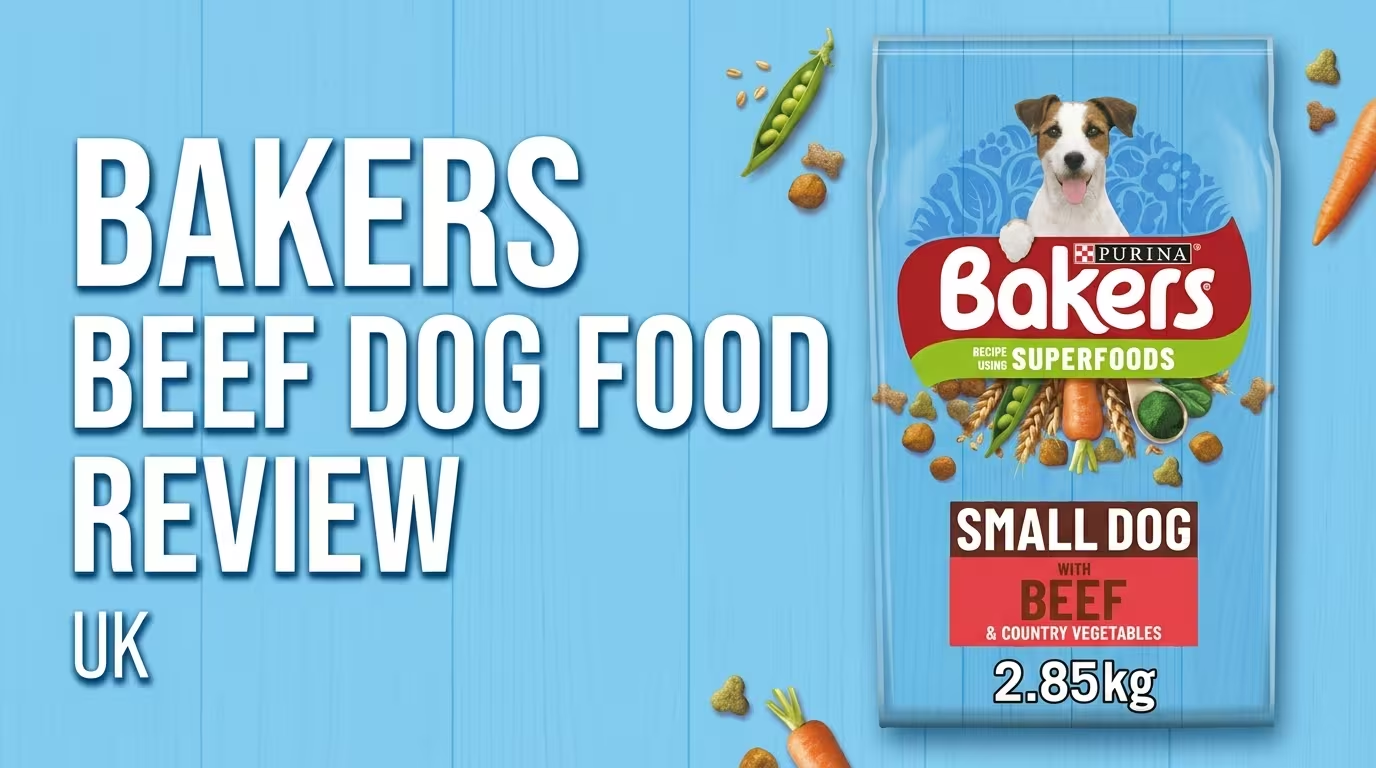
Let me set the scene here. Bakers is a Nestlé Purina brand that’s enormously popular in the United Kingdom — it’s been a British household staple for decades and consistently ranks among the best-selling dog foods in the UK market. In the USA, it’s essentially unavailable in mainstream retail channels, but it can be ordered through Amazon international sellers and specialty pet import sites.
I’m reviewing it because I get asked about it regularly. A lot of people in online dog communities mention Bakers, often in the context of “I used to feed this in the UK, should I order it for my dog in the US?” And there are British expats in America who genuinely want to know whether it’s worth the import hassle and premium pricing.
The short answer, which I’ll expand into 2,000 words: no, it’s not worth it. And if you’re feeding it to your dog in the UK, you should probably reconsider that too.
Here’s the full 30-day trial.
Product Overview: Bakers Adult with Tasty Beef & Country Vegetables
Bakers is manufactured by Nestlé Purina and has been sold in the UK since the 1970s. It’s positioned as a mainstream, affordable everyday dog food available at British supermarkets like Tesco, Asda, and Sainsbury’s. The colorful, multi-shaped kibble — with different colored pieces representing different “ingredients” — is visually distinctive and heavily marketed toward British dog owners looking for value pricing.
The “Beef & Country Vegetables” formula is their flagship product for adult dogs. I sourced it through an Amazon international seller for this trial.
Key Details:
- Brand: Bakers (Nestlé Purina UK)
- Formula: Adult with Tasty Beef & Country Vegetables
- Life Stage: Adult dogs (1+ years)
- Target: All breeds, all sizes (UK market)
- Primary Ingredient: Cereals (not beef)
- Available in USA: Import only — Amazon third-party sellers, UK pet import sites
- Import Price Range: $18–$40 for a 14 kg (~31 lb) bag depending on seller markup
- Where to Buy in USA: Amazon international sellers, eBay, specialty import sites
Quick Verdict: Bakers is one of the most controversial dog foods in the United Kingdom for very good reason — its ingredient list is genuinely poor, it contains artificial colors that have been linked to hyperactivity in sensitive dogs, and the nutritional profile is inadequate for healthy adult dog maintenance. For American dog owners, there is absolutely no reason to import this food at premium prices when better domestic alternatives exist for less money. I would not recommend this food to anyone.
My Three Testing Dogs
🐶 Clover — Bull Terrier, 4 Years Old, 58 lbs
Clover is my oval-headed, fearless, constantly-in-motion Bull Terrier who has the energy of a dog twice her size and the stubbornness of one three times her age. She’s muscular, athletic, and needs quality protein to maintain her build. Her short white coat is a reliable nutrition indicator — changes in coat quality and skin health show up quickly on her. She’s also had mild skin sensitivity in the past, so I was watching carefully for any reactions.
🐶 Maisie — Shetland Sheepdog, 6 Years Old, 22 lbs
Maisie is my tiny, perpetually alert, herding-everything-imaginable Sheltie who communicates her opinions through an impressive vocal range and extremely meaningful stares. She’s clever, sensitive, and anxious about change in general — food transitions always require patience with her. Her magnificent long double coat is her most stunning feature and requires serious nutritional support to maintain properly.
🐶 Clifford — Irish Wolfhound, 5 Years Old, 140 lbs
Yes, his name is Clifford. He’s a very large dog. He’s gentle, calm, moves through the world at a slow, deliberate pace, and is the kind of dog who makes strangers stop their cars to ask questions. At 140 lbs, feeding him quality food without going broke is a constant challenge. His wiry coat and large frame need quality protein and adequate fat to stay in condition.
My 1-Month Experience — The Honest Thirty Days
I did an eight-day transition for all three dogs — longer than usual given the import, the unfamiliar ingredient profile, and Maisie’s general resistance to change. All three transitioned without acute digestive upset, though Maisie spent the first four days giving her bowl the suspicious stare she reserves for situations she hasn’t fully approved yet.
🐶 Clover — Bull Terrier
Energy Levels: Clover maintained her characteristically intense energy for the first ten days or so. By week three, I noticed she was burning out earlier in her play sessions — the afternoon sprint-around-the-yard sessions that typically last 20-25 minutes were truncating to 10-12 minutes before she’d flop down and be done. Not dramatic, but consistently shorter than her baseline.
Digestion: Clover’s stools became progressively softer from week two onward. By week three, they were consistently loose — not diarrhea, but nothing close to the firm, well-formed output I consider healthy. Increased frequency too — three times a day instead of twice. High stool volume that suggested very poor nutrient absorption.
Coat Condition: Clover’s short white coat started looking duller by week two. By week three, there were occasional dry, slightly flaky patches around her shoulders and neck — the beginning signs of inadequate fat intake affecting skin health. She was scratching slightly more than her baseline, which given her mild sensitivity history, made me uneasy.
Behavior: More restless in the evenings. Started seeking out the garden to eat grass more frequently than her baseline. Both of these behaviors I associate with digestive discomfort.
Issues: Coat deterioration with skin patches beginning, persistent loose stools, energy decline by weeks three and four, and increased grass consumption. Clover’s month was not good.
🐶 Maisie — Shetland Sheepdog
Appetite: Maisie accepted the food after her initial evaluation period, eating full portions from about day five. However, by week three, she was leaving food in her bowl — which she essentially never does when a food is agreeing with her. The fact that her appetite diminished on a food that contains artificial flavor enhancers tells you something about her system’s response to the formula.
Weight Changes: Maisie went from 22.1 lbs to 21.5 lbs over the month. A 0.6 lb loss on a 22 lb dog is about 2.7% of her body weight — concerning. I was following the bag’s feeding guidelines for her weight. The weight loss despite following recommended portions suggests either the caloric claims are inaccurate or her body wasn’t absorbing nutrients efficiently. Her reduced appetite in weeks three and four also contributed.
Stool Quality: Poor. Maisie’s stools were soft and inconsistent throughout the trial. Volume was notably high for a 22 lb dog, suggesting low absorption efficiency. She also had two episodes of mild vomiting — once in week two and once in week three — which prompted me to check in with my vet. Both resolved without treatment, but their occurrence was concerning.
Coat: Maisie’s magnificent Sheltie double coat suffered noticeably. By week three, the outer coat had lost some of its typical sheen, and the undercoat felt less dense when I ran my fingers through it. The coat that I maintain carefully with regular grooming and nutritional monitoring was clearly showing stress from inadequate fat content and poor ingredient quality.
Issues: Weight loss, vomiting episodes, coat quality decline, and progressive appetite reduction made Maisie’s month the most concerning of the three dogs.
🐶 Clifford — Irish Wolfhound
Strength & Muscle Tone: This is always my primary concern with Clifford — maintaining his substantial muscle mass on a 140 lb frame. By the end of the month, I felt like his musculature was slightly less firm. Not dramatically, but the characteristic density of a well-conditioned Wolfhound’s muscles felt softer under my hands. At the protein levels and protein quality in Bakers, this is not surprising.
Immunity & Overall Health: Clifford had no acute health events during the month. His eyes stayed bright and his gums healthy. But at 140 lbs consuming large amounts of a low-quality food, the potential for nutritional deficiency to accumulate over time concerns me considerably.
Coat: Clifford’s rough, wiry Wolfhound coat became notably drier and rougher-feeling by week three. Irish Wolfhounds have demanding coats, and the inadequate fat content (which I’ll detail below) was showing clearly. The coat’s natural harshness became exaggerated — not the healthy wire of a well-nourished Wolfhound, but something that felt dry and brittle by comparison.
Any Issues: The sheer economics of this trial troubled me practically as well as nutritionally. Feeding Clifford at 140 lbs on this food — with its very low calorie density — required enormous portions. A 14 kg bag imported at $35–$40 lasted Clifford about ten days. Monthly cost for him alone was approaching $90–$120 even at the most favorable import pricing.
Nutritional Information Breakdown
European pet foods use slightly different labeling conventions than US foods, but the nutritional content is fundamentally comparable.
| Nutrient | Value | Ideal Range | Verdict |
|---|---|---|---|
| Crude Protein | 16% | 20–30% | ❌ Below minimum — inadequate |
| Crude Fat | 8% | 10–20% | ❌ Below minimum — inadequate |
| Crude Fiber | 3% | 3–5% | ✅ Acceptable |
| Moisture | 10% | Up to 12% | ✅ Standard |
| Calories | ~310 kcal/100g | — | Low energy density |
This is not a good nutritional profile for long-term feeding. This is among the worst nutritional profiles I’ve reviewed.
Protein at 16% falls below AAFCO minimum requirements for adult dogs (18%). Yes — 16%. This food doesn’t even meet American minimum standards. In the UK, FEDIAF guidelines have slightly different thresholds, but 16% is still at the absolute floor of acceptability. And the protein quality makes the number even less meaningful — the primary protein source is “cereals” (wheat, corn), not animal protein.
Fat at 8% is below the recommended minimum of 10% for adult dogs. Inadequate fat means inadequate skin and coat support (which showed clearly across all three dogs), inadequate energy density, and insufficient fat-soluble vitamin delivery. Every coat quality issue I observed traces directly to this number.
The Artificial Color Controversy:
Bakers has been publicly criticized in the UK for years over its artificial color content. The formula contains E102 (tartrazine), E110 (Sunset Yellow), E124 (Ponceau 4R), and E129 (Allura Red). In the UK, foods containing some of these additives must carry warnings that they “may have an adverse effect on activity and attention in children.” The same additives are in a dog food millions of British dogs eat daily. The UK’s PFMA (Pet Food Manufacturers’ Association) has raised concerns about artificial colors in pet food repeatedly. These dyes provide zero nutritional value and exist solely to make the colorful kibble visually appealing to human purchasers.
Ingredient Analysis — Even Worse Than American Budget Foods
Bakers uses European ingredient labeling that allows category descriptions rather than specific ingredient names. This makes the list even less transparent than American budget foods.
- Cereals (min 4% Wholegrain Wheat) — The primary ingredient is “cereals” — a catch-all category. Minimum 4% is whole grain wheat; the rest is unspecified grain products. Rating: Very Low-quality.
- Meat and Animal Derivatives (min 4% Beef) — The protein source: minimum 4% beef in a product called “Tasty Beef.” The rest is “animal derivatives” — an intentionally vague category that can include anything. Rating: Very Low-quality.
- Vegetable Protein Extracts — Another vague category used to boost protein numbers cheaply. Plant proteins of unspecified origin. Rating: Very Low-quality.
- Oils and Fats — No specification of which oils or fats. Unidentified lipid sources. Rating: Very Low-quality.
- Sugar — Sugar. As a prominent ingredient in adult dog food. There is no legitimate nutritional reason for sugar to appear this high in a dog food ingredient list. Rating: Completely Unacceptable.
Overall Ingredient Quality Rating: Very Low — among the worst I have ever reviewed, worse than American budget options like Kibbles ‘n Bits in terms of transparency.
The vague European category-based labeling (“cereals,” “meat and animal derivatives,” “vegetable protein extracts”) tells you almost nothing about what’s actually in the bag. The guaranteed minimum beef content of 4% is lower than Chappi’s 4% minimum. Sugar as a prominent ingredient is as alarming as corn syrup in American budget foods. Artificial colors from four different E-number dyes are completely unnecessary.
Pros & Cons — The Genuinely Painful Honest List
✅ Pros
- Dogs will initially eat it — artificial flavoring ensures palatability in the short term
- Cheap in the UK — in its home market, it’s very affordable for British dog owners
- Widely available in UK — convenient for British buyers (though I’d recommend they reconsider)
- Fiber content at 3% is technically acceptable
❌ Cons
- Protein at 16% falls below AAFCO minimum standards — literally inadequate by US regulations
- Fat at 8% is seriously below ideal — caused coat deterioration in all three dogs
- Sugar as a prominent ingredient — no place in responsible dog food
- Four artificial E-number dyes — linked to hyperactivity; no nutritional value
- Vague European ingredient labeling — “cereals,” “animal derivatives” tell you nothing
- Minimum 4% beef in a product marketed as “Beef”
- Maisie lost weight on recommended portions — a food that causes weight loss in a healthy dog is failing
- Maisie vomited twice during the trial
- Clover developed early skin patches and coat deterioration
- Clifford’s coat and muscle tone declined
- All three dogs had consistently soft, high-volume stools
- Must be imported to USA at premium prices
- Monthly cost for large dogs on imported pricing is absurd
Price Breakdown (USA Import Pricing — All in $)
Bakers is not sold in mainstream US retail. These are import/specialty prices:
| Bag Size | Approximate USA Import Price | Price Per Pound | Price Per Kg |
|---|---|---|---|
| 1.1 kg (~2.4 lb) | $12–$18 | ~$6.25/lb | ~$13.77/kg |
| 4 kg (~8.8 lb) | $22–$30 | ~$2.95/lb | ~$6.50/kg |
| 14 kg (~31 lb) | $35–$48 | ~$1.32/lb | ~$2.91/kg |
Import pricing varies significantly by seller and shipping costs.
Monthly Cost Estimates (USA import):
Low calorie density requires large portions, and import pricing makes this extremely poor value:
- Small dog (Maisie, ~22 lbs): ~1 cup/day → 4 kg bag lasts ~3 weeks → ~$29–$40/month
- Medium dog (Clover, ~58 lbs): ~3 cups/day → 14 kg bag lasts ~3 weeks → ~$47–$64/month
- Large dog (Clifford, ~140 lbs): ~6+ cups/day → 14 kg bag lasts ~10 days → ~$105–$144/month
Value for Money Verdict: Catastrophically poor in the USA context. You’re paying import premium prices for a food that: (1) doesn’t meet American minimum nutritional standards; (2) contains artificial colors and sugar; (3) caused health indicator declines in all three test dogs; and (4) requires ongoing international ordering logistics.
For what Clifford costs on imported Bakers ($105–$144/month), you could feed him Purina Pro Plan ($65–$75/month) or Diamond Naturals ($58–$68/month) — both vastly superior foods at significantly lower cost.
Comparison Table: Bakers vs. USA Alternatives
| Feature | Bakers Adult Beef & Veg (imported) | Royal Canin Medium Adult | Pedigree Complete | Purina ONE SmartBlend | Kirkland Nature’s Domain |
|---|---|---|---|---|---|
| Protein % | 16% | 27% | 21% | 30% | 24% |
| Fat % | 8% | 17% | 10% | 17% | 14% |
| Fiber % | 3% | 1.3% | 4% | 3% | 3% |
| Price (31 lb equivalent, $) | $35–$48 (imported) | $58–$68 | $22–$28 | $38–$44 | $35–$40 |
| First Ingredient | Cereals (vague) | Dehydrated Poultry | Corn | Chicken | Turkey Meal |
| Min. Meat % | 4% beef | Not stated | Not stated | Chicken (not stated) | Turkey (not stated) |
| Artificial Colors | Yes (4 types) | No | Yes | No | No |
| Contains Sugar | Yes | No | No | No | No |
| Meets AAFCO Minimums | NO (16% protein) | Yes | Yes | Yes | Yes |
| US Availability | Import only | Widely available | Widely available | Widely available | Costco |
| Best For | UK buyers (with reservations) | Breed-specific | Emergency only | Mid-range value | Best budget pick |
| Rating (/10) | 2.2 | 7.2 | 4.5 | 7.6 | 8.3 |
The Definitive Comparison:
Bakers doesn’t even meet American minimum nutritional standards. It sits below Pedigree — which I’ve already rated poorly — in protein content. It matches Pedigree’s artificial color problem and exceeds it with the addition of sugar. And it costs import premium pricing in the USA for this substandard product.
Is Bakers good for dogs? Based on my trial: no. Unambiguously no.
Final Rating: 2.2 / 10
| Category | Score (/10) |
|---|---|
| Ingredient Quality | 1.5 |
| Nutritional Profile | 1.5 |
| AAFCO Compliance (US standards) | 1.0 |
| Digestive Performance | 2.5 |
| Coat & Skin Health | 2.0 |
| Value for Money (USA) | 2.0 |
| Transparency | 2.0 |
| Overall | 2.2 |
Verdict: Not Recommended — One of the Worst Dog Foods I’ve Ever Reviewed, Worse Than Most American Budget Options
This is the lowest rating I’ve given any dog food in this review series. Lower than Alpo, lower than Kibbles ‘n Bits, lower than Chappi. The protein content falls below American minimum standards. The fat content is inadequate. The ingredient labeling is the least transparent of any food I’ve reviewed. It contains sugar and four artificial E-number dyes. And it failed all three of my test dogs across every meaningful health metric over 30 days.
Would I Buy It Again?
No. Absolutely not. I would NOT recommend this dog food to anyone — in the USA or in the UK.
The thirty days are done. All three dogs are back on their regular food. Clover’s skin patches have already started clearing. Maisie is maintaining her weight again. Clifford’s coat is recovering its proper texture. The speed of that reversal is its own verdict.
Who Should Buy Bakers Adult Beef & Country Vegetables?
The honest answer: no one.
- UK buyers: Please reconsider. Burns, Barking Heads, James Wellbeloved, or Lily’s Kitchen all offer dramatically better nutrition for comparable or slightly higher UK prices. Bakers’ popularity in the UK is a legacy of aggressive marketing, not nutritional quality.
- US buyers: There is no scenario where importing this food to the USA makes sense. At import pricing, you can buy Kirkland Nature’s Domain, Purina ONE, or Diamond Naturals — all of which are dramatically better foods — for the same or less money with the convenience of domestic purchase.
- British expats in the USA: I understand the comfort of familiar brands. But this food doesn’t clear the minimum nutritional bar for the US market, and the import cost makes it economically irrational. Please transition your dogs to a quality US brand.
My Honest Final Words
I went into this trial with genuine curiosity about whether Bakers’ UK reputation — which is controversial but includes many loyal buyers — translated to any real nutritional merit. It doesn’t. The ingredient list is among the most opaque and lowest-quality I’ve reviewed in twelve years. The nutritional profile fails basic adequacy thresholds by American standards. And the real-world results across three dogs over thirty days confirmed what the label suggested.
2.2 out of 10. The lowest score in my series, and I believe it’s the honest score this food deserves.
If you’re feeding Bakers to your dog — whether you’re in the UK or importing it to the USA — I’d encourage you to look at the ingredient list one more time with fresh eyes. Cereals as the first ingredient. Minimum 4% beef. Sugar. Four artificial colors. A protein percentage that doesn’t meet American minimum standards.
Your dog deserves better. Better is not hard to find.