
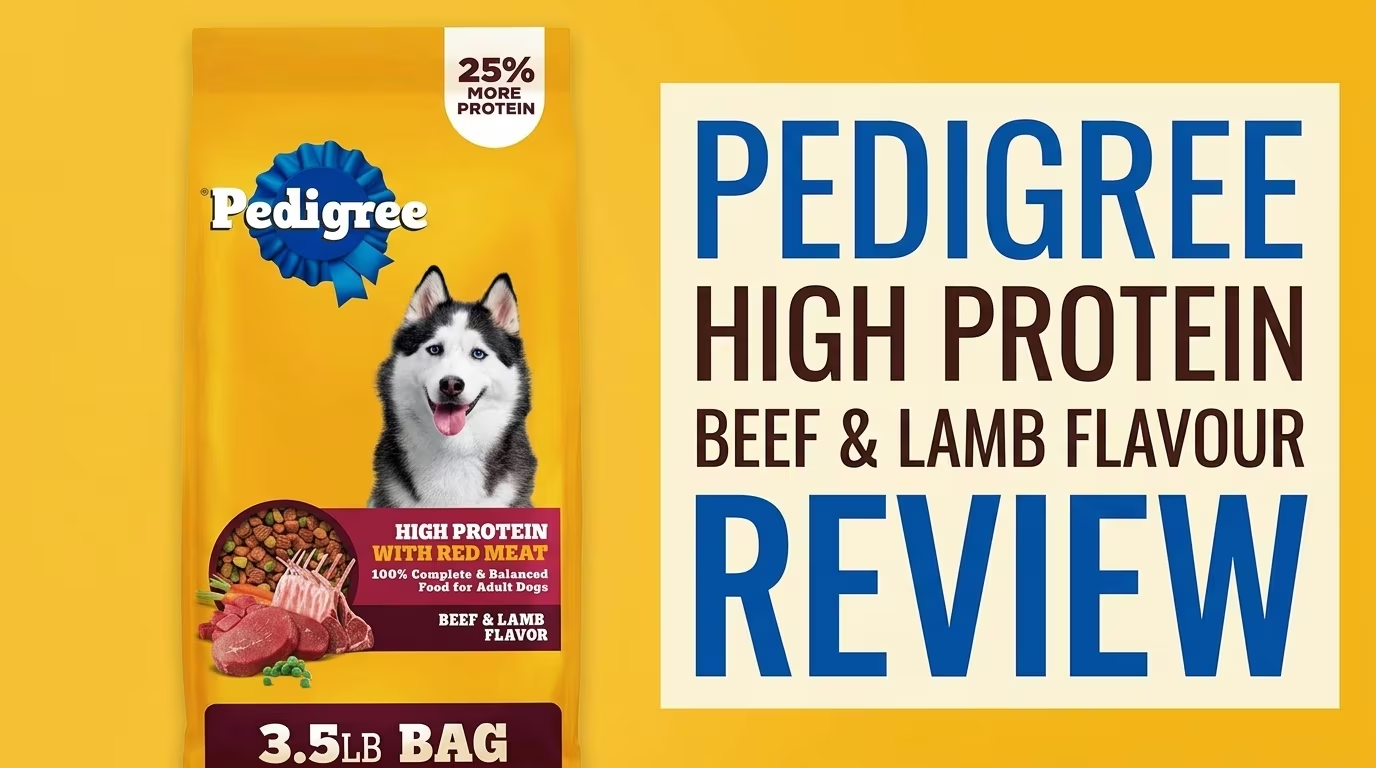
I’ve been feeding dogs for over twelve years now, and I’ll be straight with you — I wasn’t exactly excited about testing Pedigree. It’s one of those brands you see everywhere, stacked high at Walmart and Target, with commercials that tug at your heartstrings. But when a friend told me their vet actually recommended the High Protein line for their older Boxer, I got curious enough to give it a real, honest try.
So in early 2026, I bought a 36.4 lb bag of Pedigree High Protein Beef & Lamb Flavor and committed to feeding it to all three of my dogs for 30 straight days. No mixing with their regular food after the transition period. No backup plans. Just me, three very different dogs, and a month’s worth of careful observation.
What I found wasn’t what I expected — and not in a good way.
Product Overview: Pedigree High Protein Beef & Lamb Flavor
Pedigree is owned by Mars Petcare, one of the biggest pet food manufacturers in the world. The High Protein line is their attempt to compete with the premium brands pushing 30%+ protein formulas, though they’re doing it at a fraction of the cost.
This specific formula — Beef & Lamb Flavor — is marketed as providing high protein to support strong muscles, which sounds great on paper. It’s grain-inclusive, which I actually prefer given the ongoing concerns about grain-free diets and DCM (dilated cardiomyopathy) in dogs.
Key Details:
- Brand: Pedigree (Mars Petcare)
- Formula: High Protein with Real Beef & Lamb Flavor
- Life Stage: Adult dogs (1+ years)
- Target: All breeds, marketed for active or working dogs
- Primary Protein Source: Beef & Bone Meal (not fresh beef)
- Available Sizes: 18 lb, 36.4 lb, 50 lb bags
- Price Range: $22–$48 depending on size (USA retail)
- Where to Buy: Walmart, Target, Amazon, Chewy, grocery stores everywhere
Quick Verdict: Despite the “high protein” label, this food relies heavily on cheap fillers and by-product meals. Two of my three dogs developed digestive issues, coat quality declined across the board, and the ingredient list is genuinely concerning for long-term health. At this price point, there are significantly better options available. I would not feed this to my dogs again.
Meet My Three Guinea Pigs (Well, Dogs)
🐶 Charlie — Australian Cattle Dog, 4 Years Old, 45 lbs
Charlie is my high-energy working breed who needs serious fuel. He’s lean, muscular, and runs several miles with me three times a week. Cattle Dogs are prone to food sensitivities, and Charlie’s had some issues with chicken-based foods in the past, which is partly why I wanted to try a beef-based formula. His coat is short but dense, and when he’s healthy, it’s glossy and shed-resistant.
🐶 Daisy — Cavalier King Charles Spaniel, 6 Years Old, 18 lbs
Daisy is my sweet, somewhat picky little princess. Cavaliers are prone to heart issues and weight gain, so I’m always careful about what she eats and how much. Her silky coat requires decent nutrition to stay healthy, and she’s had tear-staining issues in the past that seem connected to diet quality. She’s generally a healthy dog but definitely sensitive to dietary changes.
🐶 Thor — American Bulldog, 7 Years Old, 85 lbs
Thor is my gentle giant with a sensitive stomach and a history of skin allergies. American Bulldogs are prone to food allergies, particularly to corn and wheat, which made me slightly nervous about this trial given Pedigree’s ingredient list. He’s getting older, and joint health is becoming more important. Thor will eat literally anything, so palatability testing with him is useless — but he’s excellent for observing health impacts.
My 1-Month Experience — Three Dogs, Mostly Problems
I did a standard 7-day gradual transition, mixing increasing amounts of Pedigree with their previous food. The switch went okay initially, which gave me some hope. That hope didn’t last long.
🐶 Charlie — Australian Cattle Dog
Energy Levels: For the first two weeks, Charlie seemed fine. His usual high energy was there, and he powered through our runs without issue. But around week three, I noticed he was tiring more easily. Not dramatically, but noticeably. He’d stop to rest more frequently on our usual 5-mile route, and his post-run recovery seemed slower. Whether that was the food or just an off couple of weeks, I can’t say definitively, but the timing was suspicious.
Digestion: This is where things went south. Charlie started having softer stools around day 10, and by week two, he was having loose, almost diarrhea-like poops at least once a day. They weren’t quite liquid, but they were definitely not the firm, well-formed stools he normally has. The frequency also increased — he went from pooping twice a day to three or four times. And the smell? Absolutely horrible. Way worse than usual.
Coat Condition: Charlie’s coat got noticeably duller by week three. That nice gloss he usually has just… disappeared. He also started shedding significantly more, to the point where I was vacuuming daily instead of every few days.
Behavior: Charlie seemed slightly more irritable than usual. He snapped at Thor once over a toy, which is very unlike him. Could’ve been unrelated, but I’m noting it.
Issues: The digestive problems were the dealbreaker. Persistent soft stools for three weeks straight is not normal for Charlie, and they only resolved after I switched him back to his regular food.
🐶 Daisy — Cavalier King Charles Spaniel
Appetite: Daisy ate it, but not enthusiastically. She’s a bit picky anyway, but she seemed less interested in mealtime than usual. She’d leave food in her bowl sometimes, which she rarely does.
Weight Changes: Daisy started at 18.2 lbs and ended at 18.8 lbs. That’s over half a pound in a month for a dog her size, which is significant. I was feeding exactly what the bag recommended for her weight, so the weight gain caught me off guard. The calorie density of this food is higher than I realized, and it’s clearly easy to overfeed.
Stool Quality: Daisy’s stools were consistently soft throughout the trial. Not diarrhea, but mushier than ideal. She also had more gas than normal — not room-clearing, but definitely noticeable.
Activity: Daisy’s energy seemed fine. She’s not a super active dog to begin with, so there wasn’t much to compare.
Issues: The weight gain was my main concern. Cavaliers are already prone to obesity and heart problems, and gaining weight this quickly isn’t good for her. Her tear staining also got noticeably worse by week three — those brown streaks under her eyes were more prominent than they’d been in months.
🐶 Thor — American Bulldog
Strength & Muscle Tone: Thor maintained his overall body condition throughout the month. At 27% protein (which Pedigree markets heavily), he didn’t lose muscle mass, which is good. But he also didn’t look any better or more defined — just maintained.
Immunity & Overall Health: No major health crises, thankfully. But Thor did develop some mild itching around week two that progressively got worse. By week four, he was scratching himself multiple times a day, particularly around his neck and belly. When I checked his skin, it was slightly red and irritated in spots.
Coat: Thor’s short coat became dry and rough-feeling. He also started shedding more than usual, leaving white hairs all over the furniture.
Digestion: Thor, surprisingly, had the least digestive issues of the three dogs, though his stools were still softer than ideal. He’s got an iron stomach though, so this isn’t saying much.
Issues: The skin irritation was a major red flag. Thor has a history of food allergies, and the itching + skin redness is a classic sign that something in the food isn’t agreeing with him. Given that corn meal is the #1 ingredient (more on that below), I’m not surprised.
Nutritional Information Breakdown
Let’s look at what Pedigree High Protein actually delivers nutritionally.
| Nutrient | Value | Ideal Range | Verdict |
|---|---|---|---|
| Crude Protein | 27% | 20–30% | ✅ Good — meets high-protein claim |
| Crude Fat | 14% | 10–20% | ✅ Acceptable — middle of the range |
| Crude Fiber | 3% | 3–5% | ⚠️ Low — minimum acceptable level |
| Moisture | 12% | Up to 12% | ✅ Standard |
| Calories | ~350 kcal/cup | — | Moderate-to-high calorie density |
What This Actually Means:
The 27% protein looks impressive on paper, and it’s genuinely higher than many budget foods. But here’s the problem: where is that protein coming from?
Looking at the ingredient list (which we’ll break down below), a significant chunk of that protein is from beef & bone meal, meat & bone meal (which doesn’t even specify the animal source), and corn gluten meal — not high-quality, easily digestible animal protein. These are cheap protein sources that boost the percentage on the label without providing the same nutritional value as fresh meat.
Fat at 14% is adequate but nothing special. It’s enough to meet basic needs but isn’t generous enough to really support optimal coat health, which explains why all three dogs had coat quality issues.
Fiber at 3% is the bare minimum. Higher fiber (4-5%) generally helps with satiety and digestive health, and I think the low fiber contributed to the digestive problems and Daisy’s weight gain.
Real Meat vs. Fillers:
Here’s where it gets ugly. The primary ingredients are corn meal and meat & bone meal. Not fresh beef. Not even beef meal specifically. “Meat & bone meal” is one of the vaguest, lowest-quality protein sources in commercial dog food — it’s rendered product from unspecified animals. It could be beef, pork, chicken, or a mix, and you have absolutely no way to know.
The formula is also loaded with grain fillers: corn, wheat, sorghum. These are cheap carbohydrate sources that provide calories but limited nutritional value. For dogs like Thor with corn sensitivities, this is a recipe for allergic reactions.
Additives:
Pedigree includes synthetic vitamins and minerals to meet AAFCO minimum standards, but the overall quality of the base ingredients is so low that they’re essentially trying to fortify junk food. There are also artificial colors added (Yellow 5, Red 40, Yellow 6, Blue 2) which serve zero nutritional purpose and are purely cosmetic. Some studies suggest these dyes may contribute to hyperactivity or allergic reactions in sensitive dogs.
This is not a good nutritional profile for long-term feeding. The protein percentage is technically high, but the quality is poor, and the reliance on corn, wheat, and unspecified meat by-products is concerning.
Ingredient Analysis — What’s Really In This Food?
Let’s break down the top 5 ingredients:
- Corn Meal — Ground corn. A cheap filler grain that provides calories but limited nutrition. Common allergen for dogs. This is the #1 ingredient, which tells you everything you need to know about this food’s priorities. Rating: Low-quality.
- Meat and Bone Meal — Rendered product from unspecified animal sources. Could be any combination of mammals. Low transparency, low quality. Rating: Low-quality.
- Beef & Bone Meal — At least this one specifies beef, which is better than generic “meat meal.” Still a rendered by-product, not fresh meat. Rating: Low-to-Average quality.
- Whole Grain Wheat — Another grain filler. Provides energy but limited nutrients. Another common allergen. Rating: Low-quality.
- Soybean Meal — Plant-based protein used to cheaply boost protein numbers. Dogs don’t digest plant protein as efficiently as animal protein. Rating: Low-quality.
Overall Ingredient Quality Rating: Low. This is a grain-heavy, filler-loaded formula with minimal high-quality animal protein. The first ingredient is corn — not beef, not lamb, not anything resembling quality meat. The protein sources are vague by-product meals. Four of the top five ingredients are fillers.
For comparison, quality dog foods have a named meat source (chicken, beef, salmon) or meat meal as the #1 ingredient, not corn.
Pros & Cons — The Brutal Honest Truth
✅ Pros
- Affordable — this is one of the cheapest “high protein” options available
- Widely available — you can find it at virtually any store
- 27% protein — the percentage is genuinely high for the price point
- Dogs will eat it — palatability wasn’t an issue (though that might just mean it’s loaded with artificial flavoring)
- No major acute health emergencies — nobody got violently ill
❌ Cons
- Corn meal is the #1 ingredient — not beef, despite “Beef & Lamb Flavor” on the bag
- “Meat and bone meal” is vague and low-quality — you don’t even know what animal it’s from
- Heavy reliance on cheap grain fillers — corn, wheat, sorghum dominate the formula
- All three dogs developed digestive issues — soft stools, increased frequency, bad odor
- Coat quality declined noticeably in all three dogs — dullness, dryness, increased shedding
- Thor developed skin irritation and itching — likely from corn/wheat allergies
- Daisy gained weight quickly — calorie-dense and not satiating
- Contains artificial colors — Yellow 5, Red 40, etc. — no nutritional value, potential allergens
- Low fiber (3%) — contributes to digestive issues and poor satiety
- Protein quality is poor — mostly from by-product meals and corn gluten, not fresh meat
Price Breakdown (USA — All Prices in $)
| Bag Size | Approximate Price | Price Per Pound | Price Per Kg |
|---|---|---|---|
| 18 lb | $20–$24 | ~$1.22/lb | ~$2.69/kg |
| 36.4 lb | $34–$40 | ~$1.00/lb | ~$2.20/kg |
| 50 lb | $42–$50 | ~$0.90/lb | ~$1.98/kg |
Prices based on Walmart, Target, Amazon, Chewy as of early 2026.
Monthly Cost Estimates:
- Small dog (Daisy, ~18 lbs): ~1 cup/day → 18 lb bag lasts ~4.5 weeks → ~$17–$21/month
- Medium dog (Charlie, ~45 lbs): ~2.5 cups/day → 36.4 lb bag lasts ~4 weeks → ~$34–$40/month
- Large dog (Thor, ~85 lbs): ~4.5 cups/day → 50 lb bag lasts ~3 weeks → ~$56–$67/month
Value for Money Verdict: On paper, the price looks appealing. In reality, you’re paying for low-quality ingredients that caused health issues in all three of my dogs. When Charlie’s digestive problems required extra vet visits and stool testing ($180), and I had to buy skin-soothing wipes for Thor ($25), the “savings” disappeared fast.
There are better budget options (Kirkland, Purina ONE, Diamond Naturals) that cost only slightly more but use dramatically better ingredients. Is Pedigree good for dogs? Not based on my experience.
Comparison Table: Pedigree High Protein vs. Competitors
| Feature | Pedigree High Protein Beef & Lamb | Royal Canin Medium Adult | Purina Pro Plan Chicken & Rice | Kirkland Nature’s Domain | Diamond Naturals Beef |
|---|---|---|---|---|---|
| Protein % | 27% | 27% | 26% | 24% | 25% |
| Fat % | 14% | 17% | 16% | 14% | 16% |
| Price (35–40 lb bag, $) | $34–$40 | $58–$68 | $52–$62 | $35–$40 | $38–$45 |
| First Ingredient | Corn Meal | Dehydrated Poultry | Chicken | Turkey Meal | Beef Meal |
| Contains By-Products | Yes | Yes | Yes (minimal) | No | No |
| Grain-Free | No | No | No | Yes | No |
| Artificial Colors | Yes | No | No | No | No |
| Best For | Extreme budget only | Breed-specific | Performance/active dogs | Budget-conscious quality | Mid-range value |
| Rating (/10) | 4.3 | 7.2 | 7.9 | 8.2 | 7.8 |
Where Pedigree Stands:
When comparing the best dog food in USA 2026, Pedigree High Protein falls into the bottom tier. It’s cheaper than premium brands, but the ingredient quality is so poor that the “value” is questionable. Kirkland Nature’s Domain costs virtually the same ($35–$40 for a comparable bag) but uses turkey meal as the first ingredient with no by-products or artificial colors.
Final Rating: 4.3 / 10
| Category | Score (/10) |
|---|---|
| Ingredient Quality | 3.0 |
| Nutritional Profile | 5.5 |
| Digestive Performance | 3.5 |
| Coat & Skin Health | 3.0 |
| Palatability | 6.5 |
| Value for Money | 4.5 |
| Overall | 4.3 |
Verdict: Below Average — Not Recommended
Pedigree High Protein Beef & Lamb sounds good in theory — 27% protein at an affordable price. But the execution is terrible. The protein comes from low-quality by-product meals and corn gluten, the formula is loaded with cheap grain fillers, and all three of my dogs developed health issues during the trial.
Charlie had persistent digestive problems. Daisy gained unwanted weight and had increased tear staining. Thor developed skin irritation from likely corn/wheat allergies. All three had declining coat quality.
Would I Buy It Again?
Absolutely not. I would NOT recommend this dog food.
The month-long trial convinced me that Pedigree High Protein is false advertising. Yes, the protein percentage is high, but the quality is terrible. The #1 ingredient is corn meal, not beef. The “meat” is vague by-product meals from unspecified sources. The food is packed with allergens (corn, wheat, soy) and artificial colors that serve no purpose.
I switched all three dogs back to their regular food immediately after the trial ended, and within a week, Charlie’s stools firmed up, Thor’s itching decreased significantly, and everyone’s coat started looking better.
If you’re feeding this to your dog currently and they seem fine, I’d still encourage you to look at the ingredient list and consider upgrading. Just because a dog can survive on low-quality food doesn’t mean they’re thriving.
Who Should (and Shouldn’t) Buy This
Might be acceptable for:
- Emergency situations only — if it’s literally this or your dog doesn’t eat, fine
- Very short-term feeding — a week or two while you’re between bags of better food
NOT recommended for:
- Any dog with food sensitivities or allergies — corn, wheat, and soy are all present
- Dogs prone to skin issues — Thor’s reaction was predictable given the ingredients
- Breeds prone to weight gain — the calorie density is deceptive
- Active or working dogs — despite the “high protein” label, the quality won’t support performance
- Anyone who can afford even $5-10 more per month — upgrade to Kirkland, Diamond Naturals, or Purina ONE
- Dog owners who care about ingredient quality — this isn’t it
My Final Honest Take
I’ve been doing this dog food review thing for a long time, and I genuinely try to give every brand a fair shot. I wanted Pedigree High Protein to be good. I wanted the affordable price tag to come with decent quality. But it doesn’t.
The ingredient list is genuinely bad — corn-heavy, loaded with vague by-product meals, packed with common allergens. The “high protein” marketing is misleading because the protein comes from low-quality sources. And most importantly, my dogs’ health declined during the trial.
If you’re on a tight budget, I get it. Dog food is expensive, especially if you have multiple dogs or a large breed. But there are better budget options that cost only slightly more. Kirkland Signature costs the same and is dramatically better. Purina ONE costs about $4-8 more per month and uses real chicken as the first ingredient.
Your dog’s nutrition is one of those things where cutting corners now often leads to bigger expenses later — vet bills for allergies, skin issues, digestive problems. Invest the extra few dollars per month. It’s worth it.
Pedigree High Protein Beef & Lamb gets a 4.3/10 from me, and honestly, that feels generous given the month we just had.