
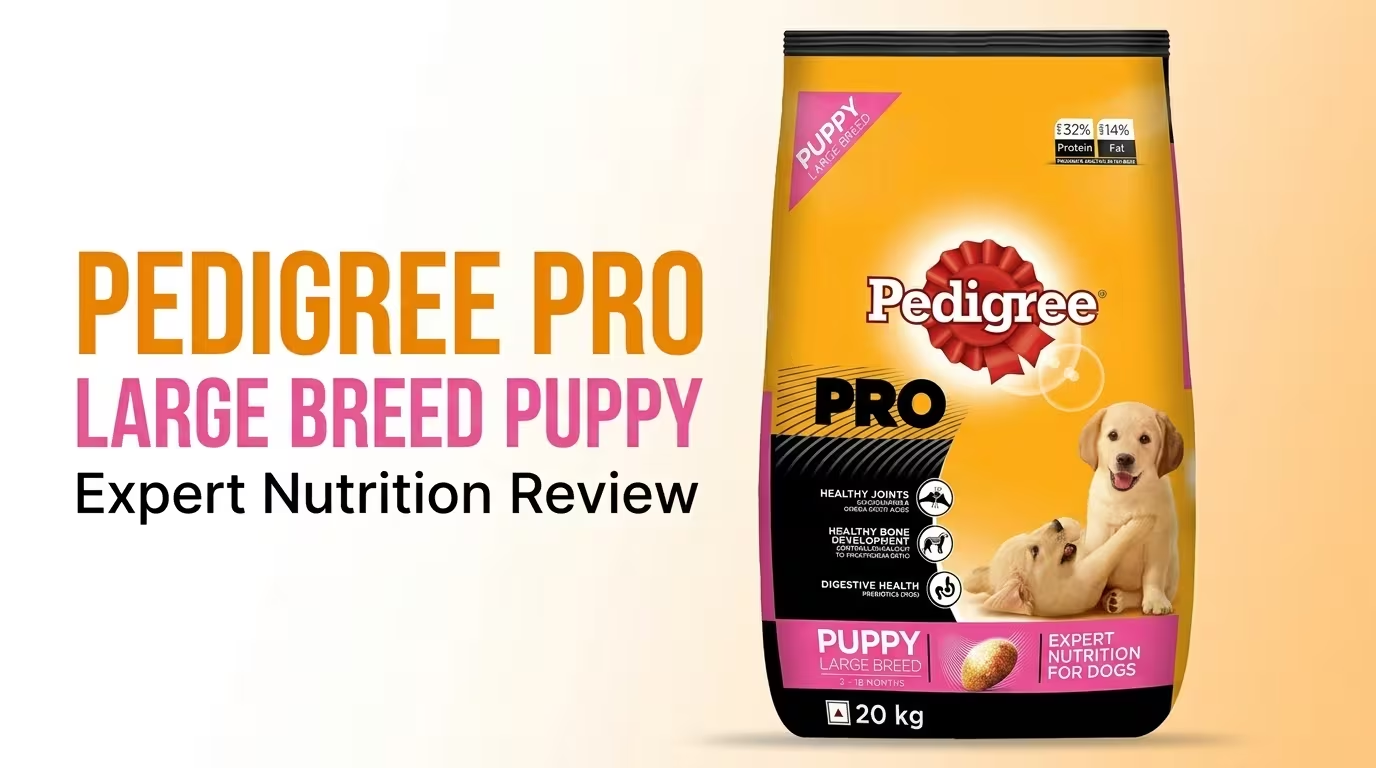
Raising large breed puppies is both a joy and a massive responsibility—literally. When I found myself with three large breed puppies at different stages in early 2026 (one mine, two foster puppies I ended up keeping), I knew nutrition was going to be critical. Large breed puppies have very specific needs, especially when it comes to controlled growth to prevent skeletal problems later. I’d been feeding premium brands, but with three fast-growing dogs, the cost was adding up quickly. That’s when I saw Pedigree PRO Expert Nutrition for Large Breed Puppy at my local pet store—it’s marketed as a step above regular Pedigree with veterinary-grade nutrition, but at a mid-tier price. I decided to give it a full 30-day trial to see if this could be a smart compromise between quality and affordability.
Here’s what actually happened during that month.
Product Overview
Brand: Pedigree PRO (Professional line)
Product: Expert Nutrition for Large Breed Puppy (Dry Kibble)
Main Ingredients: Chicken, chicken by-product meal, brewers rice, whole grain corn, poultry by-product meal
Suitable For: Large breed puppies (breeds expected to reach 50+ lbs as adults)
Price Range: $1.35–$1.70 per lb ($2.98–$3.75 per kg)
Bag Sizes: 6 lb, 15 lb, 33 lb, 50 lb
Made In: USA
Special Features: Controlled calcium/phosphorus for large breed growth, DHA for brain development
Quick Verdict
Pedigree PRO Expert Nutrition for Large Breed Puppy is a mid-tier puppy food that attempts to bridge the gap between budget and premium brands, with mixed results. It features chicken as the first ingredient and includes controlled calcium/phosphorus ratios appropriate for large breed growth, which is genuinely important. However, it also contains chicken by-product meal, corn, and multiple grain fillers. After one month, my three large breed puppies grew appropriately without skeletal issues, but I noticed softer stools in two of them, and the ingredient quality still reflects Pedigree’s budget-oriented roots despite the “PRO” branding. It’s functional for large breed puppies if you’re budget-constrained, but it’s not the optimal nutrition I’d choose if I could afford better.
Rating Preview: 5.5/10 (Average—Better than regular Pedigree, but still compromises)
My 1-Month Personal Experience with 3 Large Breed Puppies
Testing puppy food on large breeds is nerve-wracking because you’re literally building their skeleton and muscular system. Any nutritional mistakes during this stage can lead to lifelong problems. Here’s how each puppy responded.
Puppy 1: Nova (Newfoundland, 5 months old, 48 lbs)
Nova is my sweet, gentle Newfie puppy who’s already the size of many adult dogs and will probably hit 130+ lbs when fully grown. Newfoundlands are prone to hip dysplasia and other skeletal issues, so proper nutrition during growth is absolutely critical.
Energy Levels: Nova maintained good, steady energy throughout the month. Newfies aren’t hyper dogs—they’re calm and gentle—and she stayed consistent with her moderate energy level. No unusual sluggishness or hyperactivity. She still enjoyed her walks and playtime but was content to nap most of the day, which is normal for the breed.
Digestion: This is where things got problematic. Starting around day 6, Nova’s stools became noticeably softer—not liquid diarrhea, but definitely mushier than the firm poops I want to see in a healthy puppy. This persisted through the entire month despite giving her system time to adjust. I strongly suspect the combination of corn, brewers rice, and by-product meal wasn’t sitting well with her stomach. The stool volume was also quite large, which typically indicates poor digestibility and lots of filler passing through undigested.
Coat Condition: Nova’s thick, water-resistant Newfie coat stayed reasonably healthy-looking. Newfoundlands naturally have beautiful coats, and hers maintained decent texture and moderate shine. Nothing spectacular, but not terrible either. At 12% fat, Pedigree PRO provides adequate (but not generous) fat for coat health.
Behavior: She remained her typical sweet, gentle self. No behavioral changes or signs of discomfort beyond the digestive stuff. She ate her meals enthusiastically—Newfies are generally good eaters, and she showed no hesitation with this food.
Overall: Nova grew appropriately (gained about 8 lbs over the month, which is healthy for a 5-month Newfoundland), but the persistent soft stools concerned me. For a breed prone to digestive sensitivity, this food wasn’t ideal.
Puppy 2: Titan (Great Pyrenees, 6 months old, 62 lbs)
Titan is my livestock guardian puppy who thinks he’s already on duty protecting the household. Great Pyrenees are calm, independent, and can be stubborn. They’re also giant breed dogs who need very controlled growth to prevent bone and joint problems.
Appetite: Titan has always been a somewhat picky eater, which is actually common for Great Pyrenees. Surprisingly, he ate Pedigree PRO willingly. Not enthusiastically—he’d sniff it first, maybe walk away and come back—but he’d finish his portions without me having to coax him. The chicken as the first ingredient likely made it more palatable than grain-first foods.
Weight Changes: I weighed Titan weekly because proper weight gain is crucial for giant breeds. He went from 62 lbs to 71 lbs over the month—about 9 lbs of gain, which is appropriate for a 6-month Great Pyrenees. The controlled calcium (1.2%) and phosphorus (1.0%) are designed to prevent too-rapid growth, and it seemed to work. He didn’t shoot up too fast, which is exactly what you want.
Stool Quality: Similar to Nova, Titan’s stools were on the softer side throughout most of the month. Not as problematic as Nova’s, but definitely not the firm, easy-to-pick-up poops I prefer. The frequency also increased—instead of 2-3 times per day, he was going 3-4 times. The high grain content and by-product meals were clearly not optimally digestible.
Activity: Titan maintained his typical Great Pyr energy level—calm, watchful, occasional bursts of running. He wasn’t lethargic, but he also didn’t have the boundless puppy energy some breeds have. At 27% protein, Pedigree PRO provided adequate protein for his moderate activity level.
Overall: Titan grew properly without skeletal issues, which is the most important thing for a giant breed puppy. However, the digestive issues and grain-heavy formula weren’t ideal.
Puppy 3: Finn (Irish Setter, 5.5 months old, 44 lbs)
Finn is my energetic, goofy Irish Setter puppy who never stops moving. Setters are athletic hunting dogs who need quality nutrition to support their high energy and rapid growth. While not quite as giant as Nova and Titan, Irish Setters are still considered large breed dogs (60-70 lbs as adults).
Strength & Muscle Development: Irish Setters should be lean, athletic, and muscular. Over the month, Finn maintained good muscle development and gained about 6 lbs (44 to 50 lbs), which is appropriate for his age. At 27% protein, he had adequate building blocks for muscle, though I would’ve preferred 29-32% for such an active sporting breed puppy.
Immunity: No health issues during the month—no ear infections, skin problems, or digestive crises beyond the soft stool issue. His immune system seemed fine. Finn’s generally a healthy puppy anyway, but it’s worth noting there were no concerning health events.
Overall Health: Here’s what I noticed—Finn’s beautiful mahogany coat didn’t have quite the same shine and richness I’d seen on his previous food (which was higher in omega-3s). Irish Setters should have gorgeous, flowing, silky coats, and while Finn’s coat wasn’t unhealthy, it just looked… okay. Not spectacular. The minimal fish oil and lower omega-3 content in Pedigree PRO showed in his coat quality.
Issues: Finn had the softest stools of all three puppies. Around week two, he actually had a couple episodes of mild diarrhea that cleared up after a day or two. His system just didn’t handle the corn and by-products as well as the other two. Given that Irish Setters can have sensitive stomachs, this food wasn’t ideal for him.
Additionally, Finn seemed slightly less satisfied after meals. He’d finish his portion (about 3.5 cups per day split into three meals) and then scavenge around looking for more. The lower fat content (12%) and grain-heavy formula meant he wasn’t getting the same caloric density and satiety he’d had on his previous food.
Overall: Finn grew appropriately and stayed active, but the digestive issues and slightly dull coat made me uncomfortable continuing long-term.
Nutritional Information Breakdown
Let’s look at what Pedigree PRO actually delivers for large breed puppies:
| Nutrient | Pedigree PRO Value | Ideal Range (Large Breed Puppy) | Verdict |
|---|---|---|---|
| Protein | 27.0% | 25–32% | Acceptable |
| Fat | 12.0% | 12–18% | Minimum |
| Fiber | 4.0% | 3–5% | Good |
| Moisture | 10.0% | 10–12% | Normal |
| Calcium | 1.2% | 1.0–1.5% | Good |
| Phosphorus | 1.0% | 0.8–1.3% | Good |
| DHA | 0.06% | 0.05–0.15% | Low-Average |
| Glucosamine | 400 mg/kg | 300–800 mg/kg | Acceptable |
| Vitamin E | 140 IU/kg | 50+ IU/kg | Good |
| Calories | 365 kcal/cup | — | Moderate |
What This Means for Growing Large Breed Puppies
Protein (27%): This is acceptable for large breed puppies, sitting right in the middle of the ideal range. Large breed puppies actually need moderate protein—not too high, not too low—to support muscle development without forcing too-rapid growth. The protein comes from chicken, chicken by-product meal, and poultry by-product meal. While chicken as the first ingredient is good, the heavy reliance on by-product meals means the protein quality is questionable.
Fat (12%): This is the bare minimum for puppies. Fat provides energy, supports brain development (critical in puppies), aids coat health, and helps absorb fat-soluble vitamins. At only 12%, you’re getting the legal minimum but not the optimal amount for thriving puppies. I would’ve preferred 15-18% for growing large breed dogs. This explains why Finn’s coat wasn’t as shiny and why all three puppies seemed less satisfied.
Calcium (1.2%) and Phosphorus (1.0%): This is actually one of the strong points of this formula. The calcium-to-phosphorus ratio is about 1.2:1, which is appropriate for large breed puppies. Too much calcium can cause developmental orthopedic disease in large breeds, so the controlled levels here are genuinely important. This is where Pedigree PRO earns the “Expert Nutrition” part of its name—they got this critical ratio right.
DHA (0.06%): DHA is an omega-3 fatty acid essential for brain and eye development in puppies. Pedigree PRO contains a minimal amount from fish oil. It’s above the bare minimum, but premium puppy foods typically have 0.10-0.15%. This is adequate but not generous.
Glucosamine (400 mg/kg): For large breed puppies who will have significant joint stress as adults, glucosamine helps support cartilage development. 400 mg/kg is decent—not as high as premium formulas, but better than many budget foods that have none at all.
Real Meat vs. Fillers
The first ingredient is chicken, which is legitimately good. However, “chicken” is about 70% water. Once cooked and the moisture is removed, it shrinks significantly. Looking at the rest of the list:
- Chicken by-product meal (#2) – Rendered chicken parts (organs, feet, necks) not used for human consumption
- Brewers rice (#3) – Grain byproduct, cheap filler
- Whole grain corn (#4) – Another grain filler, common allergen
- Poultry by-product meal (#5) – Even vaguer than chicken by-product meal—could be from any poultry
So after the fresh chicken, you immediately hit two different by-product meals and two grains. This is fundamentally a grain-and-by-product-based food with some chicken added. The protein primarily comes from questionable sources, and the grains bulk it up cheaply.
Additives
The Good:
- Controlled calcium/phosphorus for proper bone growth
- Added DHA for brain development
- Glucosamine for joint support
- Added vitamins and minerals
- Natural preservatives (mixed tocopherols)
The Concerning:
- Chicken by-product meal AND poultry by-product meal – Two different by-products in the top 5
- Corn – Common allergen, less digestible than rice
- Artificial colors (Red 40, Yellow 5, Yellow 6) – Why are we putting dyes in puppy food?!
- Added sugar – Listed further down; completely unnecessary
My Honest Assessment
This nutritional profile is adequate for basic large breed puppy growth, but far from optimal. The controlled calcium/phosphorus ratio shows Pedigree PRO understands large breed needs, which is good. However, the heavy reliance on by-products and grains, the minimal fat content, the low DHA, and the presence of artificial colors and sugar indicate this is still fundamentally a budget food with some targeted improvements, not a truly premium large breed puppy formula.
All three of my puppies grew at appropriate rates without skeletal issues, so it meets the basic requirement. But the digestive problems in all three suggest the ingredient quality isn’t high enough for optimal health.
Ingredient Analysis
Let’s break down what’s actually in the bag.
Top 10 Ingredients:
- Chicken – Real meat (good, but mostly water)
- Chicken By-Product Meal – Rendered chicken parts (feet, organs, intestines)
- Brewers Rice – Rice byproduct from beer brewing, cheap filler
- Whole Grain Corn – Grain filler, common allergen
- Poultry By-Product Meal – Vague rendered poultry parts (chicken, turkey, any bird)
- Corn Gluten Meal – Plant protein from corn, used to boost protein % cheaply
- Animal Fat (preserved with BHA and citric acid) – Vague fat source
- Fish Oil – Omega-3 source (good!)
- Natural Flavors – Undefined flavoring
- Dried Beet Pulp – Fiber source
Major Red Flags
TWO Different By-Product Meals in Top 5: Having both chicken by-product meal AND poultry by-product meal tells you the bulk of the protein is coming from low-quality rendered animal parts. By-products are organs, feet, beaks, intestines—the parts not used for human food. While not toxic, they’re inconsistent in quality and less digestible than whole meat or even quality meat meals.
THREE Corn Products: Whole grain corn (#4), corn gluten meal (#6), and you’ll find more corn derivatives further down. This is grain-heavy formula with corn dominating. Many dogs are sensitive to corn, which likely explains the soft stools in all three of my puppies.
Brewers Rice (#3): This is basically the leftover fragments of rice after brewing beer. It’s used because it’s extremely cheap, not because it’s nutritious. It’s a classic filler ingredient.
Artificial Colors: Red 40, Yellow 5, and Yellow 6. Puppies don’t care what color their kibble is. These are purely for marketing to make the kibble look appealing to humans. Some studies link these dyes to behavioral issues and allergies. They have no place in puppy food.
Added Sugar: Why is there sugar in puppy food? It’s listed as “sugar” plain and simple. This is purely for palatability—to make dogs eat low-quality food—and it’s completely unnecessary and unhealthy.
“Animal Fat” Preserved with BHA: “Animal fat” could be from any animal—inconsistent sourcing. Worse, it’s preserved with BHA (Butylated Hydroxyanisole), which is a controversial preservative some studies have linked to health issues. Better brands use natural preservatives like mixed tocopherols.
What’s Missing
- No quality whole meats beyond the first ingredient (no deboned chicken, turkey, beef, salmon)
- No quality carbohydrates (sweet potatoes, peas, lentils—just cheap grains)
- Minimal fish oil (only 0.06% DHA)
- No probiotics (would’ve helped with the digestive issues I saw)
- No superfoods or antioxidants (blueberries, cranberries, spinach)
- No chelated minerals (less bioavailable standard minerals)
Ingredient Quality Rating: Below Average to Average
This is Pedigree trying to dress up their budget formula with some targeted improvements for large breeds. The chicken first is good. The controlled calcium/phosphorus is genuinely important. The added glucosamine is nice. But the foundation is still by-products, cheap grains, artificial colors, and sugar. It’s better than regular Pedigree, but it’s nowhere near premium quality.
Pros & Cons (Based on Real 1-Month Experience)
✅ Pros
- Controlled calcium/phosphorus ratio: Critical for large breed skeletal health—they got this right
- All three puppies grew appropriately: No too-rapid growth or skeletal issues
- Chicken as first ingredient: Better than grain-first foods
- Added glucosamine: Supports joint development in large breeds
- Contains DHA: For brain development (though minimal amount)
- More affordable than premium brands: $1.35–$1.70/lb is mid-tier pricing
- Widely available: Easy to find at most pet stores
- Titan ate it willingly: Even my picky Great Pyr accepted it
- Made in USA: Domestic production
- 50 lb bag option: Cost-effective for multi-puppy households
❌ Cons
- All three puppies had soft stools: Persistent digestive issues throughout the month
- Heavy on grains and by-products: Corn, brewers rice, and two by-product meals dominate
- Contains artificial colors: Red 40, Yellow 5, Yellow 6—completely unnecessary
- Contains added sugar: No reason for this in puppy food
- Low fat content (12%): Bare minimum for puppies
- Finn’s coat lost some shine: Lower omega-3s showed in coat quality
- Large stool volume: Indicates poor digestibility and fillers
- Finn had brief diarrhea episodes: System didn’t handle it well
- “Animal fat” with BHA preservative: Vague sourcing and controversial preservative
- Minimal fish oil: Only 0.06% DHA
- Three corn products: Nova, Titan, and Finn all struggled with digestion
- Puppies seemed less satisfied: Lower fat meant less satiety
Would I Buy This Again?
No, I would not continue feeding Pedigree PRO—even though it’s marketed for large breed puppies. Here’s my honest reasoning:
The digestive issues alone are disqualifying. All three of my large breed puppies—different breeds, different digestive sensitivities—had softer stools and increased frequency. That’s a clear sign the food isn’t digesting well. Add in the artificial colors, the sugar, the heavy reliance on by-products and corn, and the lower fat content, and I just can’t justify continuing.
However, I will acknowledge that all three puppies grew at appropriate rates with good calcium/phosphorus ratios, and none showed signs of developmental bone issues. So if someone is truly budget-constrained and choosing between Pedigree PRO and regular Pedigree (or similar budget brands), the PRO version is the better choice for large breed puppies because of the controlled minerals.
But if you can afford even $0.40-0.60 more per pound, you can get significantly better large breed puppy formulas from Purina Pro Plan, Hill’s Science Diet, or Royal Canin that don’t have the artificial junk and provide better digestibility.
Price Breakdown (USA Pricing)
Here’s what you’re actually spending:
Retail Prices (as of 2026):
- 6 lb bag: ~$9.99 ($1.67/lb)
- 15 lb bag: ~$23.99 ($1.60/lb)
- 33 lb bag: ~$46.99 ($1.42/lb)
- 50 lb bag: ~$67.99 ($1.36/lb)
Price per kg: Approximately $3.00–$3.68 per kg
Monthly Cost Estimates (for large breed puppies):
- Medium-large puppy (45 lbs like Finn): ~$50–65/month (feeding ~3.5 cups/day)
- Large puppy (50 lbs like Nova): ~$60–75/month (feeding ~4 cups/day)
- Giant puppy (65 lbs like Titan): ~$75–95/month (feeding ~5 cups/day)
Value for Money
At $1.36–$1.67 per pound, Pedigree PRO sits in the mid-tier price range. Let’s compare to other large breed puppy options:
- Regular Pedigree Puppy: $0.85–1.10/lb (lower quality, not large breed-specific)
- Pedigree PRO Large Breed Puppy: $1.36–1.67/lb (what we’re reviewing)
- Purina Pro Plan Large Breed Puppy: $1.85–2.25/lb (significantly better quality)
- Hill’s Science Diet Large Breed Puppy: $2.30–2.80/lb (premium quality)
- Royal Canin Giant Puppy: $2.90–3.60/lb (top-tier, breed-specific)
Is it worth the price?
This is where it gets complicated. Pedigree PRO is cheaper than premium brands, but you’re getting what you pay for. The question is: Is saving $0.50-0.80 per pound worth the compromises?
For my three puppies eating a combined ~12 cups per day, Pedigree PRO cost about $185/month. Upgrading to Purina Pro Plan Large Breed Puppy would cost about $255/month—a difference of $70/month or $2.30/day.
For that extra $70/month, I’d get:
- 29% protein (vs. 27%)
- 16% fat (vs. 12%)
- 0.10% DHA (vs. 0.06%)
- NO by-products as main protein
- NO artificial colors or sugar
- Better digestibility (firmer stools)
- Higher quality ingredients overall
To me, $70/month during the most critical growth stage is absolutely worth it for three large breed puppies who will grow into 60-130+ lb adults. Poor nutrition now could mean hip dysplasia, elbow problems, or other skeletal issues that cost thousands in vet bills later.
My verdict: Pedigree PRO is not good value. You’re paying mid-tier prices for what’s essentially budget quality with some targeted mineral adjustments.
Comparison Table: Pedigree PRO vs. Other Large Breed Puppy Foods
| Feature | Pedigree PRO LB Puppy | Royal Canin Giant Puppy | Pedigree Puppy | Purina Pro Plan LB Puppy |
|---|---|---|---|---|
| Protein % | 27% | 30% | 28% | 29% |
| Fat % | 12% | 14% | 14% | 16% |
| Calcium/Phos Ratio | 1.2:1 | 1.25:1 | N/A | 1.3:1 |
| Price ($/lb) | $1.36–1.67 | $2.90–3.60 | $0.85–1.10 | $1.85–2.25 |
| First Ingredient | Chicken | Chicken | Corn | Chicken |
| By-Products? | Yes (2nd & 5th) | Minimal | Yes (2nd) | No |
| Artificial Colors? | Yes (3 dyes!) | No | Yes | No |
| Added Sugar? | Yes | No | Yes | No |
| Ingredient Quality | Below Average | Premium | Low | Good |
| Nutrition Score | 5.5/10 | 9/10 | 4/10 | 8/10 |
| Best For | Tight budgets only | Optimal growth | Not large breeds | Active large puppies |
| Overall Rating (/10) | 5.5 | 9.0 | 4.0 | 8.0 |
Key Takeaway: Pedigree PRO is better than regular Pedigree but significantly worse than Purina Pro Plan or Royal Canin. For $0.50-1.00 more per pound, you get dramatically better quality without artificial junk.
Final Rating: 5.5/10 (Average – Better Than Regular Pedigree, Still Not Good)
After one month of testing Pedigree PRO Expert Nutrition for Large Breed Puppy on three different large breed puppies, here’s my final honest verdict:
Quality: 4/10 – By-products, corn, artificial colors, sugar drag it down
Nutrition: 6/10 – Adequate calcium/phosphorus, but low fat and questionable protein quality
Palatability: 7/10 – All three ate it (partly due to added sugar and flavoring)
Digestibility: 4/10 – All three had soft stools throughout the month
Value: 5/10 – Mid-tier price for budget-quality ingredients
Overall: 5.5/10 – Average, Not Recommended Unless Necessary
Would I Buy This Again?
No, I would not. Despite the “PRO” and “Expert Nutrition” marketing, this is still fundamentally a Pedigree budget formula with some calcium/phosphorus adjustments for large breeds. The persistent digestive issues in all three puppies, the artificial colors and sugar, the heavy reliance on by-products and corn, and the minimal fat content make this unsuitable for the critical first year of a large breed puppy’s life.
My Final Honest Opinion
Pedigree PRO feels like a marketing exercise—take the budget Pedigree formula, adjust the calcium/phosphorus for large breeds, add minimal DHA and glucosamine, slap on “Expert Nutrition” branding, and charge $0.50 more per pound. It’s better than feeding regular Pedigree to a large breed puppy (which you absolutely shouldn’t do), but it’s not meaningfully better than mid-tier alternatives that cost similar amounts.
What frustrates me most is that Pedigree clearly knows what large breed puppies need (controlled minerals, DHA, glucosamine) but still includes completely unnecessary garbage like artificial colors and sugar. Why? Because it’s cheaper to use low-quality ingredients and make them palatable with dyes and sweeteners than to use quality ingredients that dogs naturally want to eat.
The digestive issues speak volumes. When all three of my puppies—different breeds, different sensitivities—struggle with soft stools on the same food, that’s not coincidence. That’s poor digestibility from low-quality proteins and heavy grain content.
For large breed puppies specifically, nutrition during the first year literally builds their skeleton. This is when bones are growing, joints are forming, and the foundation for their entire adult life is being laid. Cutting corners to save $50-70 per month feels dangerously short-sighted when those puppies could develop hip dysplasia, elbow dysplasia, or other orthopedic issues that cost $3,000-8,000 to treat.
My professional recommendation:
If you’re currently feeding Pedigree PRO because it’s marketed for large breeds and seems affordable:
- If you can possibly afford it, upgrade to Purina Pro Plan Large Breed Puppy, Hill’s Science Diet Large Breed Puppy, or Royal Canin breed-specific puppy formulas. The $50-100/month difference is worth it.
- If you’re genuinely budget-constrained, Pedigree PRO is better than regular Pedigree or feeding a non-large-breed formula, but:
- Add a probiotic supplement for digestion
- Add fish oil for omega-3s
- Watch their growth carefully (monthly vet weigh-ins)
- Plan to upgrade as soon as financially possible
- Monitor for issues: If your puppy has soft stools, seems constantly hungry, or develops skin/coat problems, the food isn’t working regardless of price.
I would NOT recommend Pedigree PRO Expert Nutrition for Large Breed Puppy except as a last-resort option if you literally cannot afford better.
Final Rating: 5.5/10 – Average, not recommended
Who Should (and Shouldn’t) Buy Pedigree PRO Large Breed Puppy
⚠️ Maybe Acceptable For (Short-Term Only):
- Extreme budget constraints – If you truly can’t afford $2/lb puppy food
- Temporary financial hardship – Bridge option for 1-2 months
- Better than regular Pedigree – If you’re currently feeding regular Pedigree, PRO is an upgrade
- Rural areas with limited options – If premium brands aren’t available near you
❌ NOT Recommended For:
- Giant breed puppies – Titan (Great Pyrenees) and Nova (Newfoundland) needed better
- Puppies with sensitive stomachs – All three had digestive issues
- Breeds prone to skeletal issues – Hip/elbow dysplasia runs in Nova and Titan’s breeds
- Active sporting breed puppies – Finn (Irish Setter) needed more fat for energy
- Anyone who can afford $20+ more per month – The upgrade is worth it
- Long-term primary diet – Use this only as a short-term solution
- Health-conscious owners – The artificial colors and sugar are disqualifying
✅ Much Better Alternatives:
Best Value Upgrade:
- Purina Pro Plan Large Breed Puppy ($1.85–2.25/lb) – Significantly better for only $0.50/lb more
Premium Options:
- Hill’s Science Diet Large Breed Puppy ($2.30–2.80/lb) – Veterinarian-recommended
- Royal Canin Giant Puppy ($2.90–3.60/lb) – Breed-size-specific formula
- Eukanuba Large Breed Puppy ($2.10–2.60/lb) – Good quality, reasonable price
Budget-Friendly:
- Diamond Naturals Large Breed Puppy ($1.60–1.95/lb) – Better ingredients than Pedigree PRO
- Kirkland Signature Puppy (Costco) ($1.10–1.40/lb) – Surprisingly good quality if you have membership
Final Thoughts: Is Pedigree PRO Good for Large Breed Puppies in 2026?
No, it’s not good—it’s minimally adequate at best.
After 12+ years of raising dogs and testing Pedigree PRO for a full month on three large breed puppies representing different sizes (Newfoundland, Great Pyrenees, Irish Setter), I can say definitively: This food will keep your puppy growing at controlled rates due to appropriate calcium/phosphorus, but it will not provide optimal nutrition for thriving.
The evidence from my trial:
- ✅ All three puppies grew at appropriate rates (no too-rapid growth)
- ✅ Controlled calcium/phosphorus prevented skeletal stress
- ❌ All three had soft stools throughout the month
- ❌ Finn (Irish Setter) had brief diarrhea episodes
- ❌ Finn’s coat lost shine (lower omega-3s)
- ❌ Puppies seemed less satisfied (lower fat content)
The ingredient analysis confirms why:
- Two by-product meals in top 5 ingredients
- Three different corn products
- Artificial colors (Red 40, Yellow 5, Yellow 6)
- Added sugar
- Minimal DHA (0.06%)
- Low fat (12%)
- BHA preservative
The truth about “PRO” and “Expert Nutrition” branding:
This is marketing. Pedigree took their budget formula, tweaked the calcium/phosphorus ratio, added minimal DHA and glucosamine, and charged $0.40-0.50 more per pound. It’s better than regular Pedigree for large breeds, but calling it “Expert Nutrition” is generous when it still contains by-products, corn, artificial colors, and sugar.
The financial reality:
Large breed puppies are expensive. Nova, Titan, and Finn collectively ate about $185/month of Pedigree PRO. That feels like a lot of money when you’re paying it.
But here’s the reality check: A single hip dysplasia surgery costs $3,500-7,000. Elbow dysplasia? $2,500-5,000. If poor nutrition during the critical growth stage contributes even slightly to developmental orthopedic disease, the “savings” from cheap puppy food are immediately erased by a single surgery.
The extra $70/month to feed Purina Pro Plan instead of Pedigree PRO is $840 over the year you’re feeding puppy food. That’s less than one orthopedic surgery. It’s insurance for your puppy’s skeletal health.
My professional recommendation for large breed puppy owners:
File size
Your puppy’s first year of nutrition is the foundation for their entire adult life. Their bones are growing, joints are forming, and brain is developing. This is NOT the time to cut corners.
If you’re feeding Pedigree PRO:
- Monitor your puppy’s stools—if they’re consistently soft, the food isn’t working
- Supplement with fish oil (1000mg per 20 lbs body weight)
- Add a puppy probiotic
- Plan to upgrade to better food as soon as possible
If you can possibly afford it:
Skip Pedigree PRO entirely and invest in Purina Pro Plan, Hill’s Science Diet, or Royal Canin large breed puppy formulas. Your adult dog will thank you.
Large breed puppies only grow once. Give them the best start you possibly can.
Final Rating: 5.5/10 – Average, not recommended except as last resort