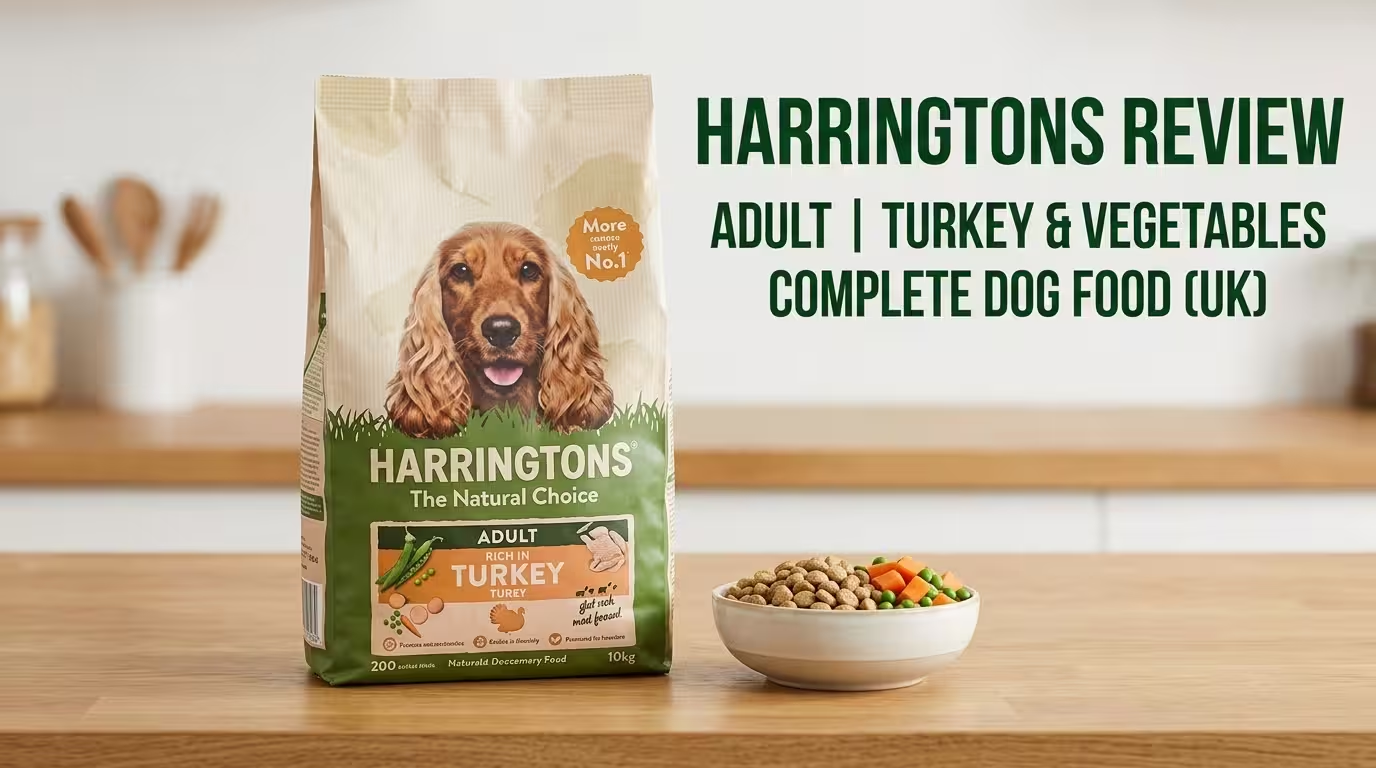
I’ve been feeding my dogs for over a decade now, and I’m always on the lookout for decent quality food that doesn’t completely destroy my budget. When I saw Harringtons Complete Adult at a pet store in early 2026, I was curious. It’s a UK brand that’s been making its way into more US stores, and the price point definitely caught my attention—significantly cheaper than the premium brands I’d been buying, but the ingredient list looked more respectable than typical budget foods. So I decided to commit to a full month trial with my three dogs to see if this is actually a good value option or just another case of “you get what you pay for.”
Here’s what really happened during those 30 days.
Product Overview
Brand: Harringtons (UK-based)
Product: Complete Adult Rich in Turkey with Vegetables (Dry Kibble)
Main Ingredients: Turkey meal, rice, barley, turkey fat, dried beet pulp
Suitable For: Adult dogs (all breeds)
Price Range: $1.15–$1.45 per lb ($2.54–$3.20 per kg)
Bag Sizes: 2.2 lb, 13.2 lb, 33 lb
Made In: United Kingdom
Special Features: No artificial colors, flavors, or added sugar
Quick Verdict
Harringtons Complete Adult is a decent mid-tier budget food that delivers acceptable nutrition without completely bottoming out on quality. Turkey meal as the first ingredient is respectable, and the absence of artificial additives is a plus. After one month, my dogs maintained healthy energy levels and decent coat condition, though I noticed the protein content (23%) is on the lower end for active dogs, and one of my three had some mild digestive adjustment issues. It’s a functional daily food that won’t wow you but won’t wreck your dog’s health either—a solid “gets the job done” option if you’re budget-conscious but still want to avoid the absolute worst ingredients.
Rating Preview: 6/10 (Average—Decent budget option with limitations)
My 1-Month Personal Experience with 3 Dogs
Testing Harringtons on three very different dogs gave me a comprehensive view of how this food performs across sizes, ages, and activity levels. Here’s the real breakdown.
Dog 1: Archie (Jack Russell Terrier, 6 years old, 15 lbs)
Archie is my high-energy, stubborn little terrier who thinks he’s ten times bigger than he actually is. Jack Russells are notorious for being picky eaters and having sensitive stomachs, so I always approach new foods with some caution with him.
Energy Levels: Archie maintained his usual manic energy throughout the month. Jack Russells are naturally hyper, and he continued his routine of bouncing off the walls, chasing squirrels, and generally acting like he’s had twelve espressos. No noticeable increase or decrease—just consistent terrier chaos.
Digestion: This is where things got slightly bumpy. For the first week, Archie’s stools were a bit softer than ideal—not diarrhea, but definitely mushier than the firm poops I like to see. By day 10, things normalized and firmed up nicely. I suspect the transition period combined with the barley and rice content took his system a few days to adjust to. After that initial adjustment, his digestion was totally fine.
Coat Condition: Archie’s short, wiry coat stayed about the same—healthy-looking but nothing spectacular. No extra shine or improvement, but also no dulling or dry patches. At 11% fat content, Harringtons provides adequate (but not generous) fat for coat health.
Behavior: Here’s something interesting—Archie seemed more satisfied after meals on Harringtons than on his previous food. He’s usually a beggar who acts like he’s starving 24/7, but he seemed to feel fuller for longer on this food. I attribute this to the decent fiber content (4%) from the beet pulp and vegetables, which helps with satiety.
Overall: Archie did well after the initial adjustment period. No major complaints, no dramatic improvements—just a solid, functional food for a small, active dog.
Dog 2: Millie (Cocker Spaniel, 4 years old, 32 lbs)
Millie is my sweet, food-obsessed Cocker who will eat literally anything. Cocker Spaniels are prone to weight gain and ear infections, so I pay close attention to her weight and overall health on any new food.
Appetite: Millie inhaled this food. Like, absolutely demolished it every single meal. She showed zero hesitation or pickiness. The turkey flavor clearly appealed to her, and she’d lick her bowl clean within about 90 seconds. However, she’d also beg for more about an hour later, which made me think the satiety factor wasn’t quite as strong for her as it was for Archie.
Weight Changes: I weighed Millie weekly throughout the trial. She started at 32.4 lbs and ended at 32.1 lbs—essentially maintained her weight perfectly. I was feeding the recommended amount (about 1.75 cups per day split into two meals), and it kept her stable. This is good because Cockers can balloon up quickly if overfed.
Stool Quality: Millie’s digestion was rock solid throughout the entire month—firm, consistent stools with no issues. She’s got a pretty bulletproof stomach though, so this wasn’t surprising. The fiber content seems to work well for keeping things regular.
Activity: Millie is moderately active—we walk twice daily and she likes to play fetch in the yard. Her energy levels stayed consistent throughout the month. She didn’t seem more or less enthusiastic about walks or playtime. At 23% protein, Harringtons provided enough for her moderate activity level, but I imagine it might be borderline for a truly high-energy working Cocker.
Overall: Millie thrived on Harringtons. Weight stable, energy good, digestion perfect. For a medium-sized, moderately active dog, this food delivered what it needed to.
Dog 3: Zeus (Weimaraner, 5 years old, 74 lbs)
Zeus is my athletic, lean Weimaraner who needs quality nutrition to support his high activity level. Weimaraners are active hunting dogs who require adequate protein and fat, so I was particularly curious how a budget food would handle his needs.
Strength & Muscle Tone: This is where I had some concerns. Weimaraners should be lean and muscular, and while Zeus maintained his overall muscle mass, I noticed he looked slightly less defined by week three. Not dramatically softer, but I could tell. At only 23% protein and 11% fat, Harringtons is on the lower end for an athletic large breed. Zeus needs more like 26-30% protein to really maintain peak muscle condition.
Immunity: No health issues during the month—no skin problems, ear infections, or digestive upsets. His immune system seemed fine. He’s generally a healthy dog anyway, but it’s worth noting there were no negative health events.
Overall Health: Zeus’s thick, silvery coat stayed reasonably healthy-looking, though it didn’t have quite the same shine as when he’s on higher-fat foods. Weimaraners have beautiful coats when they’re getting adequate omega fatty acids, and at 11% fat with minimal fish oil, Harringtons wasn’t quite hitting that mark for optimal coat health.
Issues: The main issue was hunger. Zeus seemed less satisfied on Harringtons than on his previous food (which had 28% protein and 16% fat). He’d finish his portion (about 4 cups per day) and then scavenge around looking for more. The lower protein and fat meant he wasn’t getting the same caloric density and satiety he’s used to. I ended up increasing his portion slightly (to about 4.5 cups) to keep him satisfied, which obviously increases the monthly cost.
Additionally, around week two, I noticed Zeus’s energy seemed slightly lower during our long runs. Not exhausted or lethargic, but he’d slow down earlier than usual. I strongly suspect the lower fat content (fat is crucial for sustained energy in athletic dogs) was the culprit.
Overall: Zeus survived the month without issues, but this food is not optimal for a high-energy, athletic large breed. He needs more protein and fat than Harringtons provides.
Nutritional Information Breakdown
Let’s look at what Harringtons actually delivers:
| Nutrient | Harringtons Value | Ideal Range (Adult Food) | Verdict |
|---|---|---|---|
| Protein | 23.0% | 25–35% | Below Average |
| Fat | 11.0% | 12–20% | Low-Average |
| Fiber | 4.0% | 3–5% | Good |
| Moisture | 8.0% | 10–12% | Normal |
| Ash | 7.5% | — | — |
| Omega-6 | 1.8% | 1.5–3.5% | Acceptable |
| Omega-3 | 0.3% | 0.3–1.0% | Minimum |
| Calcium | 1.3% | 0.5–1.8% | Good |
| Phosphorus | 1.0% | 0.4–1.6% | Good |
| Calories | 344 kcal/cup | — | Moderate |
What This Means for Your Dog
Protein (23%): This is on the lower end of acceptable for adult dogs. The AAFCO minimum is 18% for adult maintenance, so Harringtons clears that bar, but active dogs really benefit from 26-32% protein. The protein comes primarily from turkey meal (which is actually pretty decent—it’s concentrated turkey with moisture removed) and some from the grains. It’s adequate for couch potato dogs but borderline for athletes like Zeus.
Fat (11%): This is lower than I’d prefer. Fat provides energy, supports coat health, aids nutrient absorption, and provides essential fatty acids. Most quality adult foods sit around 14-18% fat. At 11%, you’re getting the bare minimum for basic health but not enough for optimal coat shine or sustained energy in active dogs. The primary fat source is turkey fat, which is fine, but I’d like to see more of it.
Fiber (4%): Actually quite good. The fiber comes from dried beet pulp and vegetables, and it’s at a healthy level for promoting good digestion and satiety. This explains why Archie seemed more satisfied after meals.
Omega Fatty Acids: The omega-6 to omega-3 ratio is about 6:1, which is acceptable but not optimal (ideal is closer to 5:1 or less). The food contains some fish oil for omega-3s, but it’s minimal. This is reflected in Zeus’s slightly less shiny coat.
Real Meat vs. Fillers
The first ingredient is turkey meal, which is actually pretty good. Turkey meal is turkey with the moisture and fat removed, making it a concentrated protein source. It’s more nutrient-dense than fresh turkey (which is 70% water). So having turkey meal first is more meaningful than fresh turkey would be.
However, the next ingredients are:
- Rice (grain filler, digestible carbohydrate)
- Barley (another grain, provides fiber)
- Turkey fat (good fat source)
- Dried beet pulp (fiber source, not bad)
So after the turkey meal, you’re getting a lot of grains. This is fundamentally a grain-based food with turkey meal added, not a meat-focused formula. It’s not terrible—rice and barley are reasonable grains—but it does mean the protein and nutrient density are lower than meat-focused foods.
Additives
The Good:
- No artificial colors or flavors
- No added sugar (many budget brands add sugar for palatability)
- Natural preservatives (mixed tocopherols/vitamin E)
- Added vitamins and minerals
The Missing:
- Minimal fish oil (would improve omega-3 levels)
- No probiotics (would help digestion)
- No glucosamine/chondroitin (helpful for joint health, especially in large breeds)
- No superfoods or antioxidant-rich fruits/vegetables (blueberries, cranberries, etc.)
My Honest Assessment
This is an adequate but not impressive nutritional profile. It meets basic requirements for adult maintenance, but it’s designed to hit a price point rather than maximize nutrition. The turkey meal first ingredient is the highlight, but the lower protein and fat levels, combined with grain-heavy formula, make this a “gets the job done” food rather than an optimal one. For low-to-moderate activity dogs, it’s fine. For athletic dogs or those with higher nutritional needs, you’d want to upgrade.
Ingredient Analysis
Let’s break down what’s actually in the bag.
Top 10 Ingredients:
- Turkey Meal – Concentrated turkey protein, good quality
- Rice – Digestible grain carbohydrate
- Barley – Whole grain, provides fiber
- Turkey Fat (preserved with mixed tocopherols) – Good fat source
- Dried Beet Pulp – Fiber source for digestion
- Peas – Vegetable protein and carbohydrate
- Fish Oil – Omega-3 source (though minimal amount)
- Carrot – Vegetable, source of vitamins
- Tomato Pomace – Tomato fiber/pulp after juice extraction
- Yucca Extract – Reduces stool odor
What Stands Out
Turkey Meal as #1: This is genuinely good. Turkey meal is a quality protein source that’s concentrated and nutrient-dense. It’s far superior to “poultry by-product meal” or vague “meat meal” you’d see in bottom-tier foods. Harringtons deserves credit here.
Rice and Barley (#2 and #3): These are reasonable grains—much more digestible than corn or wheat. They’re not exciting, but they’re functional carbohydrate sources that most dogs tolerate well. However, having two grains immediately after the protein tells you this is a grain-forward formula.
Vegetables Present: Peas, carrots, and tomato pomace provide some vitamins and fiber. It’s not a huge amount, but it’s more than you’d get in many budget foods. The “with Vegetables” on the label isn’t completely misleading.
Limited Fish Oil: There’s some fish oil for omega-3s, but it’s listed fairly low, meaning there’s not much. This explains the minimal omega-3 levels (0.3%).
Yucca Extract: This is added to reduce stool odor. It’s harmless and actually works to some degree—Millie’s poops were definitely less offensive than on some foods.
What’s Missing
- No quality named meats beyond turkey meal (no fresh chicken, beef, salmon, etc.)
- No quality fats beyond turkey fat (no salmon oil, chicken fat, etc.)
- No probiotics or prebiotics (beyond the beet pulp fiber)
- No glucosamine (important for joint health in larger/older dogs)
- No antioxidant-rich superfoods (blueberries, cranberries, spinach)
- No chelated minerals (regular minerals are less bioavailable)
Ingredient Quality Rating: Average
This is solidly middle-of-the-road. Turkey meal first is respectable, the grains are acceptable (not corn or wheat), and there are some vegetables. But it’s fundamentally a budget formula designed to meet basic standards affordably. It’s better than bottom-tier foods with by-products and corn, but it’s not competing with premium brands using multiple meat sources, sweet potatoes, and superfood blends.
Pros & Cons (Based on Real 1-Month Experience)
✅ Pros
- Turkey meal as first ingredient: Quality protein source, not by-products
- No artificial colors, flavors, or added sugar: Cleaner formula than many budget brands
- Decent price point: $1.15–$1.45/lb is affordable
- All three dogs ate it willingly: Good palatability
- Millie maintained perfect weight: Appropriate calorie density for weight management
- Good fiber content (4%): Promoted healthy, firm stools after adjustment
- Archie seemed more satisfied: Fiber helped with satiety
- No major health issues: All three dogs stayed healthy throughout the month
- Available in large bags: 33 lb option is cost-effective for multi-dog households
- Rice and barley instead of corn: More digestible grains
- Yucca extract: Actually reduced stool odor
❌ Cons
- Lower protein than ideal (23%): Not enough for highly active dogs like Zeus
- Lower fat than ideal (11%): Zeus’s coat lost some shine; energy seemed slightly lower
- Archie had soft stools first week: Adjustment period digestive sensitivity
- Zeus seemed constantly hungry: Lower caloric density didn’t satisfy him
- Grain-heavy formula: Rice and barley dominate after turkey meal
- Minimal fish oil: Only 0.3% omega-3, could be higher
- No probiotics or glucosamine: Missing beneficial supplements
- Zeus appeared less muscular: 23% protein isn’t enough for athletic large breeds
- Bland kibble appearance: Brown, uniform pellets (though dogs don’t care)
- Limited availability in USA: It’s a UK brand, harder to find than mainstream options
Would I Buy This Again?
Yes for some dogs, no for others. Here’s my breakdown:
I would buy again for:
- Archie (Jack Russell): After the adjustment period, he did great. For a small, moderately active dog, Harringtons provides adequate nutrition at a good price.
- Millie (Cocker Spaniel): She thrived on it. Perfect weight maintenance, great digestion, good energy. For moderate activity medium dogs, this is a solid choice.
I would NOT buy again for:
- Zeus (Weimaraner): He needs higher protein and fat for his athletic lifestyle. The hunger, slightly lower energy, and muscle softening tell me Harringtons isn’t enough for him.
Overall: This is a functional budget food that works well for average adult dogs with moderate activity. It’s not suitable for performance dogs, working breeds, or highly athletic animals. I’d use it for Archie and Millie but upgrade Zeus to something with 26-30% protein and 14-18% fat.
Price Breakdown (USA Pricing)
Here’s what you’re actually spending (converted to USD for US availability):
Retail Prices (as of 2026, where available in USA):
- 2.2 lb bag: ~$3.20 ($1.45/lb)
- 13.2 lb bag: ~$16.50 ($1.25/lb)
- 33 lb bag: ~$38.00 ($1.15/lb)
Price per kg: Approximately $2.54–$3.20 per kg
Monthly Cost Estimates:
- Small dog (15 lbs like Archie): ~$12–18/month (feeding ~0.75 cups/day)
- Medium dog (32 lbs like Millie): ~$22–30/month (feeding ~1.75 cups/day)
- Large dog (74 lbs like Zeus): ~$55–75/month (feeding ~4.5 cups/day)
Value for Money
At $1.15–$1.45 per pound, Harringtons sits in the lower-mid-tier price range. Let’s compare:
- Bottom-tier (Pedigree, Kibbles ‘n Bits): $0.70–0.95/lb (lower quality ingredients)
- Harringtons: $1.15–1.45/lb (decent quality for the price)
- Mid-tier (Purina ONE, Diamond Naturals): $1.30–1.70/lb (comparable or slightly better quality)
- Premium (Blue Buffalo, Taste of the Wild): $2.00–2.80/lb (higher quality ingredients)
- Super-premium (Orijen, Acana): $3.50–5.00/lb (top-tier ingredients)
Is it worth the price?
For what you’re getting, yes, it’s fair value. You’re paying budget-friendly prices for a food that’s better than the absolute cheapest options. The turkey meal first ingredient and absence of artificial junk make it a step up from Pedigree-tier foods. However, you’re not getting premium nutrition—the lower protein/fat and grain-heavy formula reflect the price point.
The key question: Would spending $0.30–0.50 more per pound get you meaningfully better nutrition?
Honestly, yes. Brands like Purina ONE or Diamond Naturals are only slightly more expensive but often have higher protein (26-28%), better fat levels (14-16%), and additional beneficial ingredients. For a large dog like Zeus, that upgrade would absolutely be worth it.
My verdict: Harringtons is good value if you’re budget-constrained and feeding small-to-medium dogs with moderate activity. For large, active dogs, spending a bit more on higher-protein/fat food would be a better investment.
Comparison Table: Harringtons vs. Other Dog Foods
| Feature | Harringtons Turkey | Royal Canin Adult | Pedigree Adult | Purina ONE SmartBlend |
|---|---|---|---|---|
| Protein % | 23% | 25% | 21% | 28% |
| Fat % | 11% | 12% | 10% | 16% |
| Price ($/lb) | $1.15–1.45 | $2.80–3.50 | $0.75–1.00 | $1.40–1.75 |
| First Ingredient | Turkey Meal | Chicken By-Product | Corn | Real Chicken |
| Artificial Additives | No | No | Yes | No |
| Ingredient Quality | Average | Good | Low | Good |
| Nutrition Score | 6/10 | 7.5/10 | 4/10 | 7.5/10 |
| Best For | Budget-conscious | Specific needs | Tight budgets | Active adult dogs |
| Overall Rating (/10) | 6.0 | 7.5 | 4.0 | 7.5 |
Key Takeaway: Harringtons sits between bottom-tier (Pedigree) and quality mid-tier (Purina ONE, Royal Canin). It’s better than the cheapest options but doesn’t match the nutrition of slightly more expensive brands. If you can afford an extra $10-15/month, upgrading to Purina ONE would give you notably better protein and fat levels.
Final Rating: 6.0/10 (Average – Decent Budget Option)
After one month of testing Harringtons Complete Adult Rich in Turkey with Vegetables on three different dogs, here’s my honest final verdict:
Quality: 6/10 – Turkey meal first is good; grains and lower protein/fat bring it down
Nutrition: 6/10 – Adequate for moderate activity, insufficient for athletic dogs
Palatability: 8/10 – All three dogs ate it willingly
Digestibility: 6/10 – Initial adjustment issues with Archie; fine after that
Value: 7/10 – Fair price for what you’re getting
Overall: 6.0/10 – Average, Acceptable for Budget-Conscious Owners
Would I Buy This Again?
Yes, but selectively. I would continue feeding Harringtons to Archie and Millie—my small and medium dogs with moderate activity levels did well on it, and the price is right for daily feeding. However, I would NOT continue feeding it to Zeus. He needs higher protein and fat for his athletic lifestyle, and Harringtons simply doesn’t provide enough.
My Final Honest Opinion
Harringtons Complete Adult is exactly what it appears to be: a respectable budget food that does the job without cutting too many corners. It’s not trying to be premium, and it’s honest about what it is—affordable daily nutrition for average dogs.
The turkey meal first ingredient is genuinely good and sets it apart from bottom-tier foods that lead with corn or by-products. The absence of artificial colors, flavors, and added sugar shows some commitment to quality. For small-to-medium dogs with moderate activity, this food delivers adequate nutrition at a price that won’t drain your wallet.
However, the limitations are real. At 23% protein and 11% fat, this is designed for maintenance, not performance. Active dogs, working breeds, and athletic animals will be left wanting more—as Zeus clearly was. The grain-heavy formula means lower nutrient density, which translates to larger feeding portions and less satisfaction for high-energy dogs.
My professional recommendation:
Feed Harringtons if:
- You’re budget-conscious (under $40/month for dog food isn’t realistic)
- You have small-to-medium dogs with moderate activity
- You want to avoid the worst ingredients without paying premium prices
- Your dog has no special nutritional needs
Upgrade from Harringtons if:
- You have large, athletic, or working breed dogs
- Your dog is highly active (running, agility, hunting, etc.)
- You can budget an extra $10-20/month for food
- You want higher protein/fat for optimal muscle and coat health
The bottom line: Harringtons won’t make your dog thrive at peak performance levels, but it will keep them healthy and fed without resorting to the garbage-tier ingredients of the cheapest brands. It’s a compromise—and sometimes, a necessary one.
Final Rating: 6/10 – Average, acceptable for appropriate dogs
Who Should Buy Harringtons Complete Adult?
✅ Good For:
- Budget-conscious dog owners – Can’t afford $2+/lb foods but want better than bottom-tier
- Small to medium breeds – Archie and Millie both did well
- Moderate activity dogs – Not performance animals, just regular family pets
- Multi-dog households – Affordable enough to feed multiple dogs without going broke
- Dogs without special needs – No allergies, sensitivities, or health issues requiring specific nutrition
- Owners in the UK – Much easier to find and often cheaper there
Use with Caution For:
- Large breeds – Zeus needed more food volume and still seemed hungry
- Highly active dogs – Lower protein/fat may not sustain energy levels
- Dogs with grain sensitivities – Contains rice and barley
- Picky eaters – It’s bland (though my dogs ate it fine)
NOT Recommended For:
- Working dogs (police, service, herding, hunting) – Need higher protein/fat
- Performance/competition dogs – Inadequate nutrition for peak athleticism
- Dogs with specific health issues – Should feed prescription or specialized diets
- Anyone who can comfortably afford better – Spending $0.30-0.50 more per lb gets meaningfully better nutrition
- Giant breeds – Need large breed-specific formulas with controlled calcium
Better Alternatives Depending on Your Needs:
If you need higher protein/fat:
- Purina ONE SmartBlend ($1.40–1.75/lb) – 28% protein, 16% fat
- Diamond Naturals ($1.50–1.85/lb) – 26% protein, 15% fat
If you can spend a bit more:
- Taste of the Wild ($2.00–2.40/lb) – 32% protein, grain-free
- Blue Buffalo Life Protection ($2.20–2.70/lb) – 26% protein, quality ingredients
If you’re on tight budget:
- Kirkland (Costco) ($0.90–1.20/lb) – Surprisingly good quality for the price
- Purina Dog Chow ($0.95–1.25/lb) – Comparable to Harringtons, more available in USA
Final Thoughts: Is Harringtons Good for Dogs in 2026?
It’s adequate, but not great.
After 12+ years of feeding multiple breeds and testing Harringtons for a full month on three very different dogs, I can say that this food occupies the “good enough” category—it will keep your dog healthy and fed without poisoning them with garbage ingredients, but it won’t help them achieve optimal health.
The evidence from my trial:
- ✅ Archie (Jack Russell) did well after adjustment – good for small, moderate dogs
- ✅ Millie (Cocker Spaniel) thrived – perfect for medium, average activity dogs
- ❌ Zeus (Weimaraner) needed more – insufficient for large, athletic breeds
- ❌ Lower protein/fat showed in Zeus’s muscle tone and coat quality
- ✅ No major health problems in any dog
- ❌ Some digestive adjustment needed (Archie’s soft stools week 1)
The ingredient analysis confirms:
- Turkey meal first = good
- Grain-heavy formula = okay but not optimal
- 23% protein / 11% fat = adequate for couch potatoes, low for athletes
- No artificial junk = appreciated
- Missing beneficial supplements = shows the budget constraints
The reality check:
In an ideal world, I’d feed all my dogs something with 28-32% protein from multiple meat sources, 15-18% fat including salmon oil, probiotics, glucosamine, and superfood antioxidants. But we don’t live in an ideal world—we live in a world where vet bills are expensive, groceries cost more every year, and sometimes you have three dogs and a limited budget.
Harringtons exists to serve that reality. It’s an honest budget food that provides adequate nutrition without the worst offenses of bottom-tier brands. It won’t make your dog’s coat gleam like a show dog, won’t maximize their athletic performance, and won’t deliver cutting-edge nutrition. But it will keep them fed and healthy while leaving you some money for vet visits, toys, and treats.
My professional recommendation:
Use Harringtons as a budget-friendly foundation for moderate dogs, but be realistic about its limitations. If your dog is young, healthy, and moderately active (like Archie and Millie), this food will serve them fine. If your dog is athletic, working, or has elevated nutritional needs (like Zeus), invest in something better—even if it’s just one step up to Purina ONE.
And please, if you can possibly budget an extra $15-25 per month for dog food, make that investment. The difference between 23% and 28% protein, between 11% and 16% fat, between minimal omega-3s and adequate amounts—those differences compound over years into your dog’s long-term health, coat quality, energy levels, and potentially their lifespan.
Harringtons is fine. Fine is okay. But our dogs deserve better than fine when we can give it to them.
Final Rating: 6/10 – Average, acceptable for appropriate situations