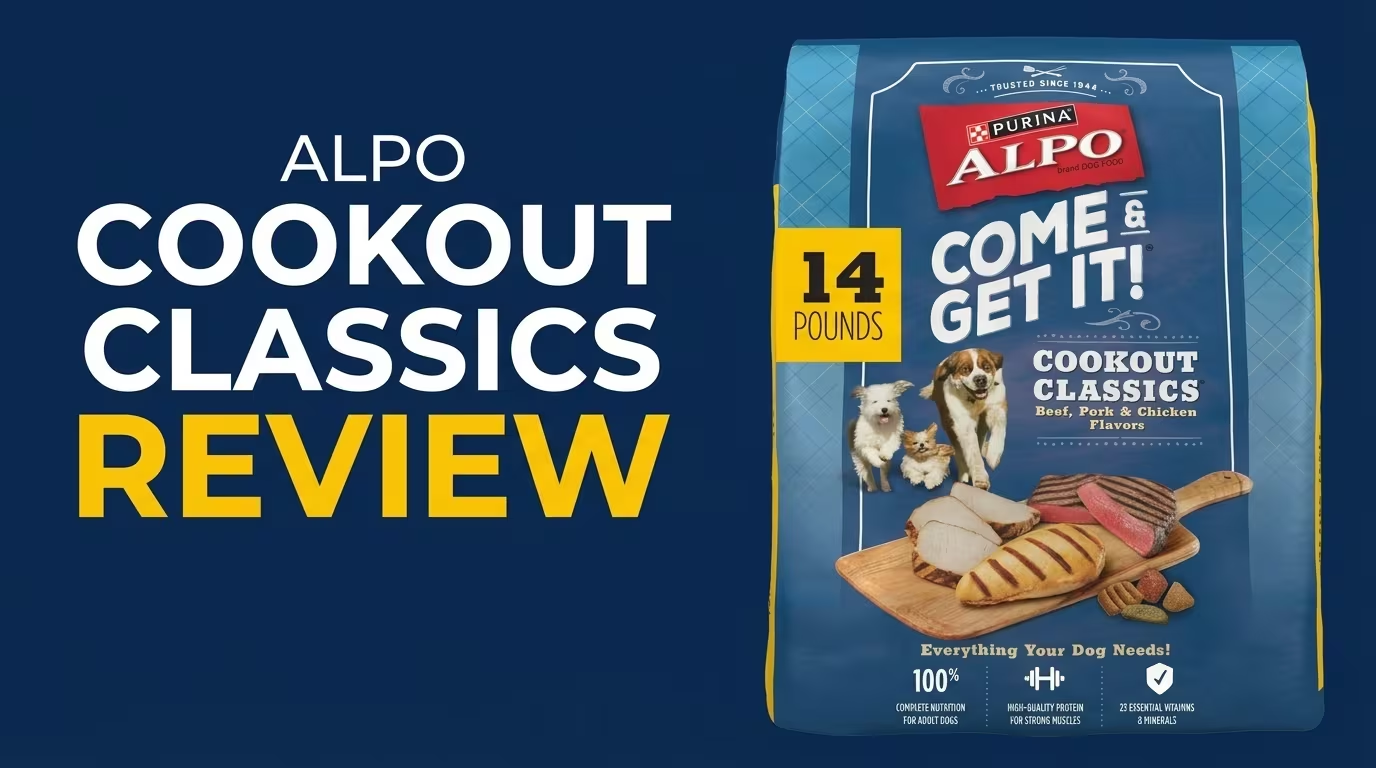
Let me tell you something I’ve believed for a long time: every dog food deserves a fair test before I write it off. I’ve been surprised in both directions over twelve years of feeding dogs — foods I expected to be terrible that turned out decent, and foods I expected to be fine that caused real problems. So when I picked up a bag of Alpo Come & Get It! Cookout Classics in early 2026, I genuinely committed to giving it a fair, month-long shot.
The name alone raises questions, I’ll admit. “Cookout Classics.” The bag has pictures of what appears to be steak and burgers. The colorful, multi-shaped kibble pieces look more like a party mix than dog food. All of this triggered my skepticism immediately. But I’ve learned not to judge entirely by packaging, and I promised myself I’d track everything the same way I always do.
Thirty days later, I have a lot to say. And unfortunately, most of it isn’t good.
Product Overview: Alpo Come & Get It! Cookout Classics
Alpo is a brand that’s been around since 1936, currently manufactured by Nestlé Purina PetCare. The Come & Get It! line is their flagship mainstream product — colorful, multi-shaped kibble with different flavored pieces designed to appeal to dogs (and, I suspect, the humans buying it based on how visually interesting it looks).
The Cookout Classics formula features “beef, chicken, and bacon flavors” — which sounds fantastic at a backyard barbecue and means something much less impressive when you look at the actual ingredient list.
Key Details:
- Brand: Alpo Come & Get It! (Nestlé Purina)
- Formula: Cookout Classics with Beef, Chicken & Bacon Flavors
- Life Stage: Adult dogs (1+ years)
- Target: All breeds, all sizes
- Primary Protein Source: Corn (not beef — we’ll get to this)
- Available Sizes: 3.5 lb, 7 lb, 16 lb, 32 lb, 52 lb bags
- Price Range: $8–$38 depending on size (USA retail)
- Where to Buy: Walmart, Target, grocery stores, Amazon, Dollar General
Quick Verdict: Alpo Come & Get It! Cookout Classics is one of the lowest-quality dog foods I’ve tested in twelve years of doing this. The ingredient list is dominated by cheap fillers, the protein comes primarily from plant sources rather than meat, and all three of my dogs showed health indicators declining during the trial. The colorful kibble and “cookout” branding is pure marketing designed to sell this food to humans, not to nourish dogs. I would not feed this food to my dogs again.
My Three Testing Dogs
I selected three dogs with different sizes, breeds, and baseline health statuses for this trial.
🐶 Birch — Gordon Setter, 5 Years Old, 58 lbs
Birch is my elegant, slightly serious sporting dog who takes everything — walks, training, mealtimes — with focused intensity. He’s got that gorgeous black and tan setter coat that requires real nutritional support to stay in good condition. He’s healthy and has no documented sensitivities, making him a good baseline indicator. When his coat quality changes, it’s reliable nutrition feedback.
🐶 Trixie — Cairn Terrier, 4 Years Old, 14 lbs
Trixie is my scrappy, fearless, seventeen-pounds-of-attitude-in-a-fourteen-pound-body terrier. She’s got that rough, wiry terrier coat, an attitude entirely outsized for her physical dimensions, and a digestive system that has historically been reliable. She eats enthusiastically without being picky. If Trixie shows digestive issues, it’s meaningful, because she almost never does.
🐶 Wallace — Mastiff Mix, 6 Years Old, 112 lbs
Wallace is my enormous, slow-moving, profoundly gentle giant who greets everyone as a long-lost friend and takes up approximately 60% of any couch he sits on. At 112 lbs, feeding him costs real money, which is actually part of why I included him — I wanted to evaluate whether any genuine cost-saving rationale could be justified for a large dog on this food. Spoiler: it cannot.
My 1-Month Experience — Three Dogs, Progressively Bad News
Six-day transition for everyone, mixing Alpo with their previous food. All three transitioned without obvious upset, which gave me some initial optimism. That optimism eroded as the weeks progressed.
🐶 Birch — Gordon Setter
Energy Levels: For the first two weeks, Birch seemed fine. His energy was consistent, his training sessions were normal, and I didn’t notice anything alarming. Around week three, though, I started noticing he was less enthusiastic about his morning runs. He’d follow me willingly but with less of that forward-leaning, can’t-wait-to-get-going energy that’s characteristic of setters. By week four, he was visibly more lethargic in the mornings than I’d ever seen him.
Digestion: This deteriorated progressively. Birch had firm stools in week one. By week two, they were softer and more frequent. By weeks three and four, he was having loose stools at least once a day, and the smell was significantly worse than I’ve come to associate with him. Loose stools every day for two weeks with no other explanation (no new treats, no table food, no environmental changes) pointed directly at the food.
Coat Condition: Birch’s striking black coat started looking dull around week two and continued getting worse. His usually glossy setter coat became flat and dry-looking. I was brushing out more dead hair than normal, and the coat’s texture felt rougher when I petted him. This is one of the clearest nutritional indicators I know, and it moved in the wrong direction consistently.
Behavior: More restless in the evenings. He started licking his paws more than usual around week three — a behavior I associate with either allergic reactions or digestive discomfort. Not constantly, but enough that I noticed and documented it.
Issues: Loose stools, coat decline, energy reduction, and paw licking. For a healthy dog with no previous issues, developing four separate concerning indicators over one month is significant. I attribute all of these to the food.
🐶 Trixie — Cairn Terrier
Appetite: Trixie ate it with initial enthusiasm. The colorful, multi-shaped kibble seemed to intrigue her — she’d nose through the bowl like she was sorting different flavors. But by week three, she was leaving bits in her bowl and walking away with less enthusiasm than at the start. I’ve never seen Trixie not finish a meal before this trial.
Weight Changes: Trixie went from 14.0 lbs to 14.8 lbs in a month — nearly a full pound on a 14 lb dog. That’s significant. I was feeding exactly per the bag guidelines for her size. The weight gain despite following recommended portions tells me the calorie density and macronutrient balance of this food doesn’t align with what its feeding guidelines suggest. This kind of unexplained weight gain on standard portions is a red flag.
Stool Quality: Not good. Trixie — who has historically had reliable digestion — had soft stools throughout weeks two and three. They improved slightly in week four but never returned to her normal firm consistency. Increased volume too, which indicates poor nutrient absorption.
Activity: Trixie’s energy was fine early in the month, but she seemed slightly less interested in her usual terrier-intensity play sessions by weeks three and four. Still active, just less… ferocious about it. Trixie at less than full ferocity is genuinely unusual.
Issues: Weight gain on standard portions and persistent soft stools were my main concerns with Trixie. The declining enthusiasm for food by the end of the month was also notable.
🐶 Wallace — Mastiff Mix
Strength & Muscle Tone: Wallace maintained his overall mass throughout the month, but I felt like his muscle tone was slightly softer by the end. Hard to quantify definitively at his size, but the kind of change you feel when you put your hands on a dog you know well. At 20% protein (more on this below), and with much of that protein coming from plant sources, I’m not surprised his muscle maintenance wasn’t optimal.
Immunity & Overall Health: Wallace had one ear infection during week three. He does occasionally get ear infections, so I can’t definitively blame the food. But the timing within a month of dietary change, combined with everything else I was observing, makes me suspicious.
Coat: Wallace’s short Mastiff-mix coat became noticeably duller by the end of the month. For a short-haired dog, this kind of change is usually obvious and significant. His skin also seemed drier when I ran my hands along his flanks.
Digestion: High stool volume — very high, actually. For a 112 lb dog eating 6+ cups of this food per day, the stool output was genuinely staggering. Massive volume on multiple occasions daily. This is a near-definitive indicator that the food isn’t being absorbed efficiently — a lot is passing through as waste rather than being utilized. His stools were also softer than normal throughout the trial.
Issues: The ear infection, coat decline, high stool volume, and soft stools accumulated into a concerning picture. Plus, feeding Wallace this food at 6 cups per day meant a 52 lb bag lasted about 2.5 weeks. The economics didn’t even work out as well as they appeared.
Nutritional Information Breakdown
| Nutrient | Value | Ideal Range | Verdict |
|---|---|---|---|
| Crude Protein | 20% | 20–30% | ⚠️ Poor — meets bare minimum, poor quality sources |
| Crude Fat | 8% | 10–20% | ❌ Below minimum — inadequate |
| Crude Fiber | 4.5% | 3–5% | ✅ Acceptable |
| Moisture | 12% | Up to 12% | ✅ Standard |
| Calories | ~320 kcal/cup | — | Low energy density |
This is not a good nutritional profile for long-term feeding.
Let me explain why each number is more concerning than it might appear.
Protein at 20% is technically the AAFCO minimum for adult dog food. Technically legal. But the quality of this protein is what really matters — and it’s almost entirely derived from corn and soy-based sources, not from actual meat. The “beef, chicken, and bacon flavors” on the packaging are flavoring agents, not meaningful protein contributions. What your dog is actually getting is plant protein with meat flavoring added. That’s a fundamentally different thing.
Fat at 8% is below the minimum of what I consider adequate. This is the lowest fat content I’ve seen in a food that claims to be “complete and balanced.” Fat is essential for skin and coat health, brain function, fat-soluble vitamin absorption, and sustained energy. At 8%, every one of my dogs was getting inadequate fat — which directly explains the coat quality declines I observed in all three.
Fiber at 4.5% is the one decent number in the formula. But fiber this high combined with such poor protein and fat creates a profile where dogs feel somewhat satiated but are nutritionally undernourished.
The Artificial Color Problem: Alpo Come & Get It! contains Red 40, Yellow 5, Yellow 6, and Blue 2. These synthetic dyes make the kibble colorful and “fun” looking. They provide exactly zero nutritional value to your dog. Some studies suggest potential links to hyperactivity and allergic reactions in sensitive animals. This is pure human marketing — your dog does not care what color their food is.
Ingredient Analysis — It’s Worse Than You Think
Top 5 ingredients:
- Ground Yellow Corn — The first ingredient is corn. Not beef, not chicken, not any meat. Corn. This is the foundation of this food — a cheap, low-nutritional-value grain that provides calories and cheap plant protein via corn gluten meal (which appears later). Rating: Low-quality.
- Soybean Meal — The second ingredient is soybean meal — another plant-based protein source used to boost the protein number cheaply. Two of the first two ingredients are plant fillers. Rating: Low-quality.
- Beef & Bone Meal — The third ingredient is finally an animal protein source, but it’s beef & bone meal — a rendered product of unspecified quality, including bone content. It’s protein, but lower-quality protein from undefined sources. Rating: Low-quality.
- Corn Syrup — I want you to sit with this for a moment. Corn syrup. In dog food. In the fourth position. This is a sugar source used entirely for palatability — to make the food taste sweet and addictive to dogs. It provides empty calories, contributes to weight gain, and has no nutritional value whatsoever for a dog. This single ingredient tells you more about this food’s philosophy than anything else I could write. Rating: Unacceptable.
- Whole Ground Wheat — Another grain filler. Provides carbohydrates. Common allergen. At this point in the ingredient list, we’ve had corn, soy, low-grade bone meal, corn syrup, and now wheat. Rating: Low-quality.
Overall Ingredient Quality Rating: Low — among the worst I’ve reviewed.
The inclusion of corn syrup in the top five ingredients is genuinely alarming. It’s there to make dogs like the food (and keep eating it), not to provide any nutritional benefit. This is a food engineered for palatability, not health.
Pros & Cons — The Uncomfortable Honest Truth
✅ Pros
- Very cheap — among the lowest price per pound of any dog food available
- Available everywhere — literally every grocery store and big-box retailer
- Dogs eat it — the corn syrup and artificial flavoring ensure most dogs will consume it willingly
- Meets AAFCO minimum standards — technically “complete and balanced” in the barest sense
- Colorful kibble is visually engaging — for humans, not dogs
❌ Cons
- First ingredient is corn, not meat — despite beef and chicken prominently featured on packaging
- Corn syrup as the fourth ingredient — sugar in dog food for palatability manipulation
- Fat at 8% is below adequate — directly caused coat quality decline in all three dogs
- 20% protein at minimum threshold, mostly from plant sources — not meaningful animal nutrition
- All three dogs had coat quality decline throughout the trial
- Birch developed persistent loose stools over weeks two through four
- Trixie gained weight on standard portions — food is metabolically problematic
- Wallace had massive stool volume indicating very poor nutrient absorption
- Contains Red 40, Yellow 5, Yellow 6, Blue 2 — artificial colors with no nutritional value
- Energy declined in two of three dogs by weeks three and four
- Artificial “cookout” flavoring is not real beef, chicken, or bacon
Price Breakdown (USA — All Prices in $)
| Bag Size | Approximate Price | Price Per Pound | Price Per Kg |
|---|---|---|---|
| 7 lb | $8–$10 | ~$1.28/lb | ~$2.82/kg |
| 16 lb | $14–$18 | ~$1.00/lb | ~$2.20/kg |
| 32 lb | $22–$28 | ~$0.78/lb | ~$1.72/kg |
| 52 lb | $30–$38 | ~$0.65/lb | ~$1.43/kg |
Prices based on Walmart, Target, Amazon as of early 2026.
Monthly Cost Estimates:
Because calorie density is low (~320 kcal/cup), you actually feed more volume than many other foods, which erodes some of the apparent savings.
- Small dog (Trixie, ~14 lbs): ~1 cup/day → 16 lb bag lasts ~4 weeks → ~$14–$18/month
- Medium dog (Birch, ~58 lbs): ~3 cups/day → 32 lb bag lasts ~3.5 weeks → ~$25–$32/month
- Large dog (Wallace, ~112 lbs): ~6 cups/day → 52 lb bag lasts ~2.5 weeks → ~$48–$61/month
Value for Money Verdict: Appears cheap on the shelf. But when you calculate the actual monthly cost — especially for large dogs like Wallace who need 6+ cups daily — the savings versus a slightly better food (like Kirkland or Purina ONE) shrink to $10–$15/month. And when you factor in potential vet bills for digestive issues, skin problems, or the long-term health costs of inadequate nutrition, the “savings” disappear entirely.
This is not good value. This is the illusion of value.
Comparison Table: Alpo Come & Get It! vs. Competitors
| Feature | Alpo Come & Get It! Cookout | Royal Canin Medium Adult | Pedigree Complete | Purina ONE SmartBlend | Kirkland Nature’s Domain |
|---|---|---|---|---|---|
| Protein % | 20% | 27% | 21% | 30% | 24% |
| Fat % | 8% | 17% | 10% | 17% | 14% |
| Fiber % | 4.5% | 1.3% | 4% | 3% | 3% |
| Price (30–35 lb bag, $) | $22–$28 | $58–$68 | $22–$28 | $38–$44 | $35–$40 |
| First Ingredient | Ground Yellow Corn | Dehydrated Poultry | Corn | Chicken | Turkey Meal |
| Contains Corn Syrup | YES | No | No | No | No |
| Artificial Colors | Yes (4 types) | No | Yes | No | No |
| Ingredient Quality | Very Low | Average | Low | Good | Good |
| Best For | Nobody, honestly | Breed-specific needs | Absolute last resort | Budget-value balance | Best budget pick |
| Rating (/10) | 2.8 | 7.2 | 4.5 | 7.6 | 8.3 |
The Honest Comparison:
Looking at the best dog food in USA 2026, Alpo Come & Get It! sits at the absolute bottom. It has lower protein than Pedigree (already a low bar). It has half the fat content of Purina ONE. Its first ingredient is corn, its fourth ingredient is corn syrup, and it contains more artificial colors than most cereals marketed to children.
For roughly $13–$15 more per month for a medium-sized dog, you can buy Kirkland Nature’s Domain with turkey meal as the first ingredient, no artificial additives, and dramatically superior nutrition. That’s the cost of three or four coffees per month. Is your dog’s health worth three coffees a month? I think most people reading this know the answer.
Is Alpo good for dogs? Based on twelve years of experience, what I observed in this trial, and what I know about canine nutrition — no. It is not.
Final Rating: 2.8 / 10
| Category | Score (/10) |
|---|---|
| Ingredient Quality | 2.0 |
| Nutritional Profile | 2.5 |
| Digestive Performance | 3.0 |
| Coat & Skin Health | 2.5 |
| Palatability | 6.0 |
| Value for Money | 3.5 |
| Overall | 2.8 |
Verdict: Not Recommended — One of the Worst Dog Foods on the Market
Corn as the first ingredient. Corn syrup as the fourth. Fat at 8%. Four artificial colors. Declining coat quality, soft stools, and energy reduction in two of three dogs over thirty days. I’ve tried to find something genuinely positive to say about this food beyond its price and availability, and I’m struggling.
The palatability is high because of the flavoring and corn syrup — dogs will eat it. But that’s like saying a candy bar is good because kids eat it enthusiastically.
Would I Buy It Again?
No. I would NOT recommend this dog food.
I switched all three dogs back to their regular food immediately after the thirty-day trial ended. Within ten days, Birch’s stools firmed up completely. His paw licking stopped. Trixie’s enthusiasm at mealtimes came back. Wallace’s coat started looking better.
That rapid improvement after returning to quality food told me everything I needed to know about what Alpo had been doing — or more accurately, not doing — for my dogs’ health.
If you’re currently feeding this food, please consider upgrading. Even spending $10–$15 more per month gets you to Purina ONE, Kirkland, or Diamond Naturals — foods that are dramatically better in every measurable way.
Who Should Buy Alpo Come & Get It! Cookout Classics?
The honest answer is: almost no one.
Absolute edge cases only:
- True financial emergency where this is the only food available and the only alternative is not feeding your dog at all
- Extremely short-term (days, not weeks) while transitioning to a better food
- Perhaps as a very occasional treat mixed into better food (and even then, I’d skip the corn syrup)
Everyone else should avoid this, including:
- Budget-conscious owners — please spend $10–$15 more and get Kirkland or Purina ONE
- Dogs with any sensitivity history — the corn, soy, wheat, and artificial additives are a minefield
- Large breed owners — you’re feeding massive volumes of low-nutrition food for marginal savings
- Dogs with coat issues — 8% fat will actively worsen coat problems
- Active or working dogs — protein quality is completely inadequate
- Puppies or seniors — both life stages need better nutrition than this delivers
- Anyone who cares about their dog’s long-term health — which I suspect is everyone reading this
My Final Honest Words
I committed to giving Alpo Come & Get It! Cookout Classics a fair trial. Thirty days, three dogs, careful tracking. And the result was one of the clearest, most consistent “no” verdicts I’ve produced in twelve years of feeding and reviewing dog food.
Corn as the first ingredient in a food with “beef” in the name. Corn syrup as the fourth ingredient in an everyday dog food. Fat content so low it’s below what most canine nutritionists consider adequate. All three of my dogs showing declining health indicators over just thirty days.
This isn’t a food that nourishes dogs. It’s a food engineered to be cheap to make and appealing to buy, with artificial colors and corn syrup to ensure dogs will eat it regardless of what’s actually in it.
Your dog will eat it. That’s not the same as your dog thriving on it.
The colorful bag will catch your eye. The low price will seem attractive. The “Cookout Classics” branding will conjure images of quality grilled food. Please don’t be fooled by any of it.
2.8 out of 10, and the only reason it’s that high is because all three dogs ate it without acute illness and fiber content was acceptable. Everything else earns a failing grade.
Buy something better. Your dog is counting on you to make the right call.